




















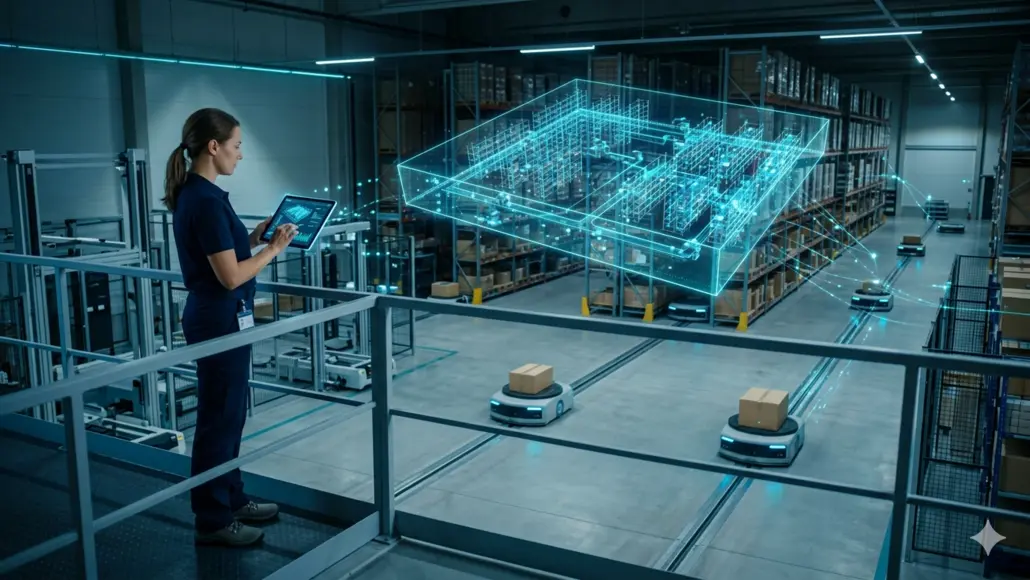
The concept of the “Digital Twin” has transitioned from a high-tech novelty in aerospace to a fundamental tool in the modern logistics arsenal. In its simplest form, a digital twin is a dynamic, virtual representation of a physical object or system in this case, an entire warehouse. By integrating real-time data from IoT sensors, inventory systems, and robotic fleets, these digital replicas provide a “live” mirror of what is happening on the floor. This technology allows logistics managers to bridge the gap between physical reality and digital analysis, enabling a level of warehouse optimization that was previously impossible. As global commerce becomes more complex and the margin for error narrower, digital twins warehouse operations are becoming the primary mechanism for maintaining a competitive edge in efficiency and reliability.
The power of a digital twin lies not just in its ability to show the current state of a facility, but in its capacity to predict the future. Traditional warehouse management relies on historical data and human intuition to make decisions. Digital twin logistics, however, uses advanced simulation to test “what-if” scenarios in a risk-free virtual environment. Operators can model the impact of a 20% increase in order volume, a change in rack layout, or the introduction of a new robotic picking system before any physical changes are made. This predictive capability reduces the risk of costly implementation errors and ensures that every operational adjustment is backed by data-driven insights. It is the ultimate tool for future-proofing the supply chain against the volatility of the modern market.
The Architecture of a Virtual Fulfillment Center
Creating a functional digital twin requires a sophisticated technological stack that begins with pervasive data collection. Every forklift, conveyor belt, and picking station must be equipped with sensors that feed data back to the central model. This “industrial internet of things” (IIoT) provides the heartbeat of the digital twin, ensuring that the virtual model is always in sync with its physical counterpart. In smart warehouses, this data stream includes everything from machine health and energy consumption to the exact location of every parcel. The result is a high-fidelity map that allows managers to zoom in on a single sorting lane or zoom out to view the entire facility’s throughput. This granularity is essential for identifying the micro-inefficiencies that, when aggregated, significantly impact the bottom line.
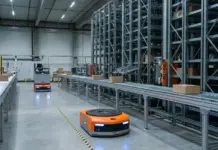
Once the data is collected, artificial intelligence and machine learning algorithms take over. These tools analyze the incoming streams to identify patterns and anomalies that a human observer might miss. For example, a digital twin might notice that a specific group of AMRs is consistently experiencing delays in a certain aisle. By cross-referencing this with inventory data, the system can determine that the aisle layout is causing congestion and suggest a more efficient traffic flow. This proactive approach to warehouse simulation moves the organization away from fire-fighting and toward a model of continuous improvement. The digital twin becomes a tireless consultant, constantly looking for ways to shave seconds off a picking route or reduce the energy load of the HVAC system.
Enhancing Real-Time Performance Monitoring and Maintenance
Beyond long-term planning, digital twins warehouse operations are invaluable for day-to-day performance monitoring. In a traditional warehouse, a manager might not know a sorting machine is underperforming until it actually breaks down or causes a significant backlog. A digital twin, however, can provide early warning signs. By comparing real-time performance against the “ideal” digital model, the system can detect subtle deviations in motor vibration or processing speed. This enables a strategy of predictive maintenance, where repairs are scheduled during planned downtime before a failure occurs. This shift from reactive to predictive maintenance is a key driver of logistics efficiency, as it minimizes the catastrophic impact of unplanned equipment failure.
Furthermore, the digital twin serves as a powerful training and collaboration tool. New employees can be onboarded in a virtual replica of the warehouse, learning the layouts and safety protocols without the risk of interfering with live operations. On a broader scale, stakeholders across the global supply chain can access the digital twin to gain a better understanding of facility capacity and constraints. This transparency fosters a more connected supply chain, where manufacturers and carriers can adjust their schedules based on the real-time status of the distribution center. The digital twin acts as a shared language between the physical world and the digital stakeholders, ensuring that everyone is working from the same set of facts.
The Path Toward Fully Autonomous Logistics Ecosystems
As we look to the future, the role of digital twins will expand from individual facilities to entire logistics networks. We are moving toward an era of “networked digital twins,” where every warehouse, port, and trucking fleet has a virtual counterpart that communicates with the others. This level of integration will allow for a truly global view of the supply chain, enabling end-to-end optimization that considers every variable from weather patterns to port congestion. The digital twin will no longer be just a mirror of a warehouse; it will be the control center for an autonomous, self-healing logistics ecosystem.
In conclusion, digital twins are the cornerstone of the next generation of warehouse optimization. By providing a platform for simulation, prediction, and real-time monitoring, they enable organizations to operate with a level of precision and agility that was once the stuff of science fiction. The transition to digital twins warehouse operations requires a significant investment in technology and data culture, but the rewards are clear: lower costs, higher throughput, and a more resilient business model. As the logistics industry continues to evolve, the ability to “see” into the future through a digital twin will be the defining characteristic of the world’s most successful supply chains. The virtual world and the physical world are finally becoming one, and the result is a more efficient world for everyone.