





























The global shift toward online shopping has created a logistical challenge of unprecedented scale. Consumers now expect a vast selection of products to be available for immediate shipment, often with next-day or even same-day delivery. For the traditional warehouse, this has made the picking process the act of retrieving individual items from shelves to fulfill an order a significant bottleneck. Historically, picking was a purely manual task, requiring a large workforce to navigate miles of aisles every day. However, the rise of robotic picking systems is fundamentally changing this dynamic. These advanced machines are now capable of performing the most complex and delicate tasks in the warehouse, driving a new era of warehouse fulfillment that is defined by speed, accuracy, and around-the-clock operation.
The core of a modern robotic picking system lies in its ability to “see” and “think” about the objects it is handling. This is achieved through the integration of high-resolution 3D cameras and sophisticated artificial intelligence. Unlike older industrial robots that were programmed to move in a rigid, repetitive path, today’s logistics robotics can identify objects of different shapes, sizes, and textures in real-time. Whether it is a soft piece of apparel, a rigid plastic bottle, or a small electronic component, the robot can determine the optimal way to grasp the item without causing damage. This level of dexterity is what allows robotic picking systems to handle the “long tail” of products that characterize modern e-commerce, making order fulfillment automation a reality for even the most diverse inventories.
The Technological Components of Precision Picking
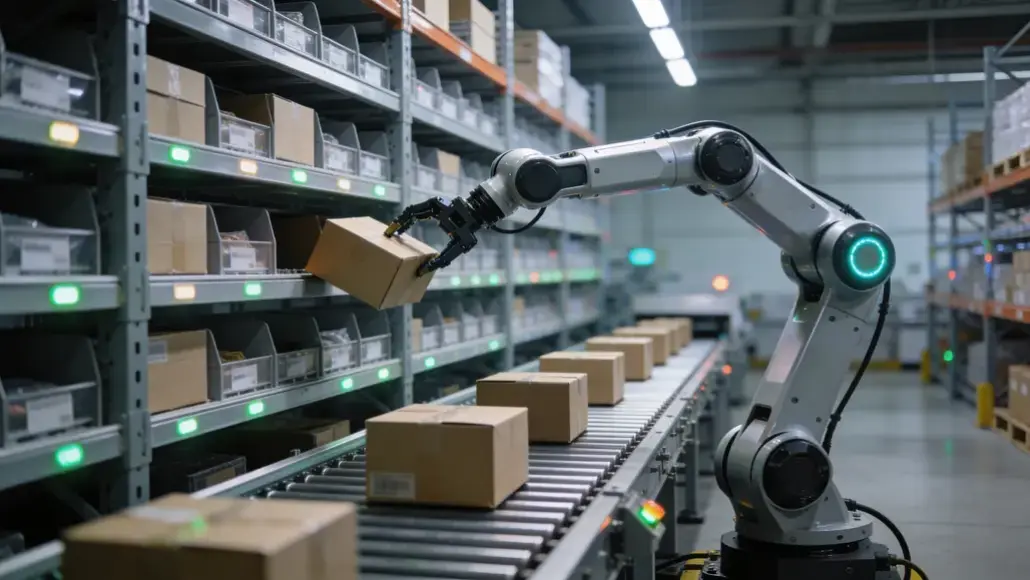
To achieve the speed and precision required for modern logistics, robotic picking systems utilize a layered approach to technology. The first layer is the computer vision system, which acts as the robot’s eyes. Using AI-driven image recognition, the system can distinguish between individual items even when they are jumbled together in a bin or on a conveyor belt. This “bin-picking” capability was long considered the “holy grail” of robotics, as it requires a high level of spatial awareness and problem-solving. Today, advanced algorithms can calculate the best approach path for the robotic arm in milliseconds, ensuring that the picking process is both fluid and efficient. This technology is the bedrock of automated picking systems, allowing them to operate with a level of autonomy that was once thought impossible.
The second layer is the end-of-arm tooling (EOAT), which acts as the robot’s hand. Depending on the application, these tools can include vacuum suction cups, soft robotic grippers, or multi-fingered mechanical hands. For high-speed fulfillment, many systems use a “swapping” mechanism that allows the robot to change its gripper in a matter of seconds to suit the next item in the queue. This versatility is crucial for warehouse fulfillment, as it ensures that the robot is never sidelined by a product it cannot handle. The combination of “smart eyes” and “capable hands” allows these systems to maintain a constant pace that far exceeds human capacity, especially during long shifts where fatigue would naturally slow down a human worker.
Integration with Warehouse Execution and Management Systems
A robotic arm is only as effective as the system that tells it what to do. The true power of robotic picking systems is realized when they are deeply integrated with Warehouse Execution Systems (WES) and Warehouse Management Systems (WMS). This connectivity allows the robots to be part of a larger, synchronized choreography. For example, an autonomous mobile robot (AMR) might bring a bin of products to a stationary robotic picking arm. The arm picks the required items and places them into a shipping carton, which then moves along an automated conveyor to the packing station. This end-to-end automation ensures that there are no “dead spots” in the fulfillment process, maximizing the overall throughput of the distribution center.
Furthermore, this integration provides a wealth of data that can be used for continuous logistics optimization. Every pick made by the robot is recorded, providing real-time visibility into inventory levels and processing speeds. If the system detects a recurring error with a specific type of packaging, it can automatically adjust the robot’s grip force or approach angle. This self-learning capability means that the robotic picking systems become more efficient over time, constantly refining their movements to shave fractions of a second off each cycle. This data-driven approach is a key differentiator for companies looking to scale their operations in a competitive marketplace where every second counts.
The Evolution of Human-Robot Collaboration in Fulfillment
As robotic picking systems become more prevalent, the role of the human warehouse worker is undergoing a significant shift. There is often a fear that robotics will lead to widespread job loss, but the reality is more nuanced. In many cases, robots are taking over the “dull, dirty, and dangerous” tasks, allowing humans to move into higher-level roles such as system maintenance, exception handling, and process management. The most successful warehouses are those that embrace a collaborative model, where humans and robots work together to solve complex problems. For instance, a human might handle items that are too fragile or uniquely shaped for the robot, while the robotic picking systems handle the bulk of the standard orders.
Looking forward, we are likely to see even more mobile and intelligent picking solutions. The emergence of “picking robots on wheels” allows for a more decentralized and flexible warehouse layout, where the robots can move to wherever the work is needed. Additionally, the integration of generative AI will allow these systems to learn even faster, adapting to new products and packaging types without the need for manual programming. The journey toward fully automated order fulfillment automation is well underway, and robotic picking systems are the primary engine driving this transformation. For businesses, the message is clear: the ability to pick and pack at the speed of thought is no longer a goal for the future it is a requirement for the present.
In conclusion, robotic picking systems are the cornerstone of the modern, high-speed fulfillment center. By providing unmatched precision, consistency, and scalability, they are helping the logistics industry meet the challenges of the e-commerce era. The transition to these automated systems is a complex undertaking that requires a deep understanding of both robotics and supply chain dynamics. However, the benefits in terms of fulfillment speed and accuracy make it one of the most important investments a logistics company can make. As technology continues to evolve, the distinction between human and machine capabilities will continue to blur, leading to a more efficient and responsive supply chain that benefits businesses and consumers alike. The age of the robotic picker is here, and it is moving faster than ever.