






















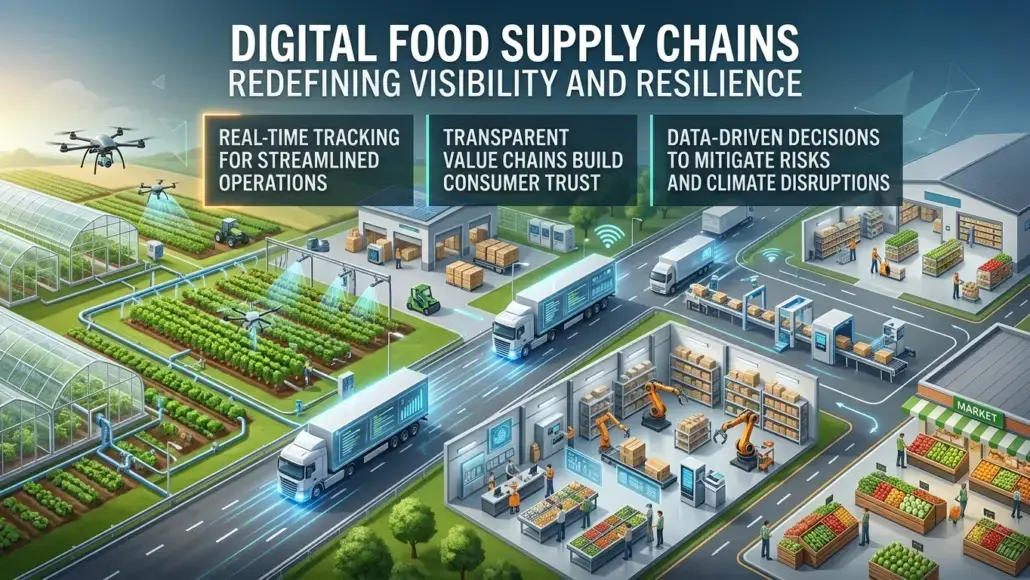
There is no shred of doubt when we say that today’s global food industry is undergoing a period of unprecedented complexity and volatility. Changing consumer tastes, with an appreciation for organic and locally sourced goods, and significant disruptions caused by political unrest and climate change mean that traditional methods of handling the food supply are no longer enough. In order to survive and thrive in such a setting, stakeholders throughout the value chain are making the shift towards digital food supply chains. These systems are not just a technological improvement, but they are a profound rethinking of how food travels from the farm to the fork, with a particular emphasis on real-time data, seamless integration, and complete transparency.
In the past, food supply chains have been broken down and have information divisions. A farmer may have little visibility into where the products go, and a retailer may find it challenging to track the exact source of the products on its shelves. This kind of dearth in transparency results in inefficiencies, contributes to food waste, and presents significant risks at the time of safety recalls. Digital food supply chains connect these divides by creating a single digital thread which is linked to all participants in the network. Companies have the ability to monitor the product with surgical accuracy and ensure the integrity of the food remains intact at every stage, thanks to sophisticated procurement technology and logistics.
The Technological Basis of Modern Food Systems
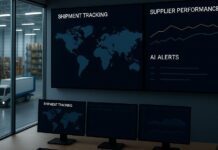
It is worth noting that a set of interrelated technologies are driving the evolution for a fully digital ecosystem. The Internet of Things – IoT – happens to be just one driving force behind this change, offering real-time visibility of goods in motion. Sensors on pallets and containers can very well track the temperature and humidity as well as location, and that too in real time. This information is very important in food logistics, where even a tiny variation in temperature can cause the decomposition of products and hence result in massive losses.
Managers can get immediate alerts when circumstances change by combining these sensors with cloud-based platforms, allowing them to take preventative steps before the quality of the product is impacted.
Interestingly, machine learning and artificial intelligence are also playing an enormous role when it comes to supply chain visibility. In supply chain management, AI can analyse massive volumes of historical and real-time data to anticipate demand patterns with impressive precision. This permits more intelligent digital purchasing methods, in which purchase orders are based on data-driven forecasts and not guesswork. Artificial intelligence can also identify potential bottlenecks within the distribution network and propose alternative routes or suppliers in order to ensure the uninterrupted movement of goods. This sort of a predictive ability is important in establishing resilient supply chains that can withstand unexpected turbulence.
Digital Traceability for Transparency Improvement
One of the major advantages of digital food supply chains is that they allow for strong food traceability. In times where consumers are more cautious than ever about where their food comes from and how reliable it is, tracking every step of the process is a competitive benefit. Digital traceability systems track every transaction as well as movement on a secure ledger, often decentralized. This ensures data integrity and openness to authorized parties. When a food safety issue comes up, these standardized systems allow for fast identification of the source, allowing for targeted recalls that prevent public health risks along with minimizing the scale of product loss.
Moreover, transparency extends far beyond safety to moral and environmental considerations. Digital procurement tools enable buyers to confirm the sustainability credentials of their suppliers. Whether it is verifying fair trade practices or guaranteeing that products are produced without any sort of harmful pesticides, digital records offer the evidence required to back up advertising claims. This sort of level of responsibility enhances the relationship between brands as well as consumers, building trust in an exceedingly sceptical market. As procurement technology continues to develop, the integration of ESG – Environmental, Social, and Governance metrics into digital platforms will evolve into standard practice.
Strategic Benefits of End-to-End Visibility
The adoption of digital food supply chains allows for a variety of strategic perks that go beyond operational efficiency. For one, end-to-end transparency allows for more effective inventory management. When every stakeholder knows where products are and when they are anticipated to arrive, they can keep leaner inventory standards, cutting down on the capital tied up in stock as well as reducing the risk of becoming obsolete. In the setting of food distribution, this is especially important as far as perishable items are concerned that have a short shelf life.
Moreover, digital food supply chains promote better collaboration between partners. In a conventional setup, communication is often responsive and transactional. In a digital network, data gets shared in real-time, facilitating a more collaborative approach when it comes to problem-solving. For instance, if a shipment is held up due to weather, the logistics provider can proactively notify the retailer, who can then modify their promotional plan or source from an alternative warehouse. This level of agility is what constitutes a truly resilient supply chain.
Overcoming the Challenges to Digital Adoption
Changing consumer tastes with a preference for organic and locally sourced products and major disruptions due to geopolitical tensions and climate change mean that the old ways of managing food distribution are no longer enough. In this environment, stakeholders along the value chain are turning to digital food supply chains to survive and thrive. These systems are not simply an upgrade in technology; they are a fundamental rethinking of the way food gets from the farm to the fork, with an emphasis on real-time data, frictionless integration and end-to-end transparency.
In the past, food supply chains have been fragmented, and information has been siloed. A farmer may have little visibility as to where the products go, and a retailer may encounter it difficult to track the exact source of the products on its shelves. This lack of transparency results in inefficiencies, contributes to food waste, and presents significant risks during safety recalls. Digital food supply chains assist in filling these gaps by creating a single digital thread linking each player in the network. Leading procurement technology and logistics technology companies can now track products with surgical precision to ensure that at every stage the integrity of the food is maintained.
The advantages are obvious, but there are some hurdles to overcome before we reach a completely digital food supply chain. One of the biggest barriers is the high initial cost of implementation. There is a need for significant capital to invest in IoT sensors, AI software, and the necessary IT infrastructure. For smaller players in the industry such as independent farmers or local distributors, these costs can be prohibitive. However, the long-term ROI in terms of reduced waste, better compliance and improved brand image often justifies the investment. Moreover, as technology becomes more pervasive, the cost of entry is slowly decreasing.
Another challenge is standardising data. For digital food supply chains to function, all players must have systems and data formats that are compatible. At present, the industry suffers from a lack of uniformity, with companies using different software and protocols. This creates friction and inhibits the possibilities of seamless end-to-end visibility. This is a barrier that has to be broken down via industry-wide campaigns and open standards. Cybersecurity is an increasing issue, too as supply chains become increasingly data-dependent, they also grow more vulnerable to cyberattacks. Protecting sensitive data and guaranteeing system uptime should be the primary concerns for any organisation going through a digital transformation.
The Prospects of Food Delivery
The digital food supply chain of the coming years is likely to be more integrated and take on new technologies such as blockchain and 5G. Blockchain will further enhance the security and transparency of food traceability, along with 5G making the data transmission from IoT devices more rapid and dependable. We might also anticipate a more significant push towards circular economy principles, with online platforms tracking not only food distribution but also waste as well as packaging material management.
In the end, digital food supply chains have a purpose of establishing a more fair, environmentally friendly, and efficient global food system. With AI embedded in supply chain management and advanced logistics technologies, we can get closer to a world where food never goes to waste, safety is ensured, and all stakeholders have the data they need to make the best choices. It represents a complex transition, but the positive effects are huge – for businesses and consumers as well as the planet.