






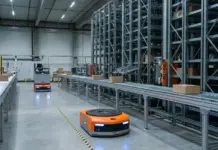




















The landscape of order fulfillment has undergone a seismic shift over the past decade, driven largely by the relentless growth of e-commerce and the consumer’s expectation for near-instant delivery. To keep pace, warehouses have had to evolve from static storage spaces into dynamic environments where speed and accuracy are paramount. At the heart of this transformation is a new generation of technology: autonomous mobile robots (AMRs). Unlike their predecessors, which relied on tracks or magnetic tape to move, AMRs represent a significant leap forward in intelligent navigation and adaptability. By utilizing advanced sensors, computer vision, and onboard processors, autonomous mobile robots warehousing solutions are proving that the future of logistics is both mobile and incredibly smart.
To understand why AMR robots are so revolutionary, one must first distinguish them from Automated Guided Vehicles (AGVs). AGVs have been around for years, but they are fundamentally limited by their need for a fixed path. If an obstacle is placed in their way, an AGV simply stops and waits for it to be removed. In contrast, an AMR uses sophisticated mapping technology often LiDAR or 3D cameras—to understand its surroundings in real-time. If an AMR encounters a stray pallet or a group of workers, it can calculate a safe path around them and continue its mission. This level of autonomy makes AMRs ideal for the “chaos” of a modern warehouse, where layouts change frequently and human activity is constant. This flexibility is the primary reason why warehouse robotics has moved from a niche experiment to a core operational strategy for global logistics leaders.
Scalability and Flexibility in the Modern Distribution Center
One of the most compelling advantages of autonomous mobile robots warehousing is the inherent scalability they offer. In a traditional automated warehouse, the infrastructure is often fixed. Installing a massive conveyor system or an automated storage and retrieval system (AS/RS) requires a significant upfront investment and months of installation time. Once in place, these systems are difficult to move or expand. AMRs, however, require no changes to the physical infrastructure of the building. A warehouse can start with just a few robots and add more as their volume increases or as peak seasons approach. This “automation as a service” model allows companies to manage their capital expenditures more effectively while ensuring they always have the capacity to meet demand.
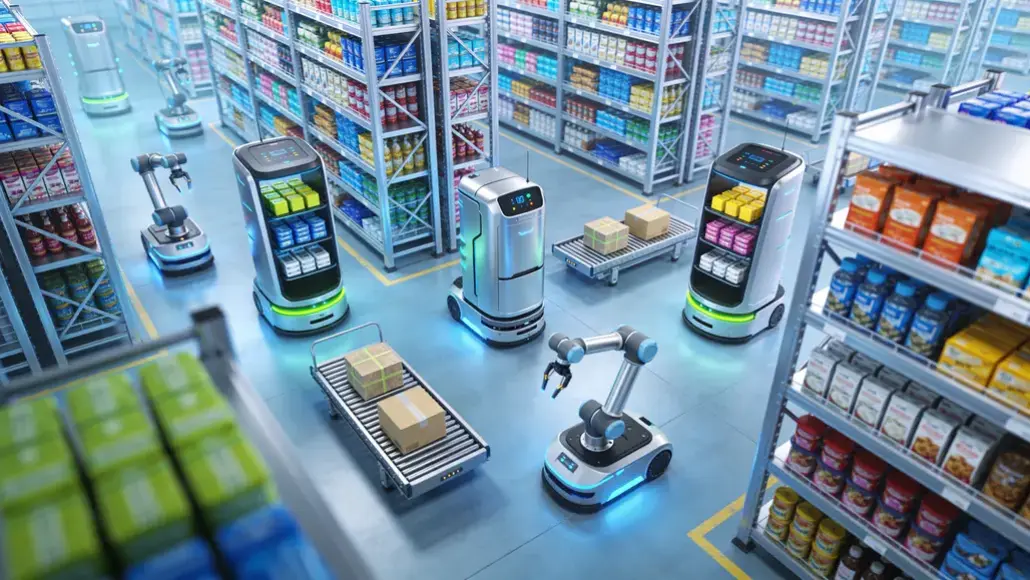
This flexibility extends to the tasks the robots can perform. Modern warehouse automation trends show a move away from single-purpose machines. Today’s AMR robots can be outfitted with various attachments, such as shelving units, conveyor tops, or robotic arms, allowing them to handle everything from small parcels to heavy pallets. This versatility means that a single fleet of robots can be repurposed throughout the day. In the morning, they might be used for inbound receiving and put-away; by the afternoon, they could be transitioned to support picking and packing operations. This high utilization rate maximizes the return on investment and ensures that the robots are always contributing to the facility’s overall throughput.
Revolutionizing Automated Picking Systems and Order Accuracy
The picking process is often cited as the most labor-intensive and error-prone part of warehouse operations. Traditional “man-to-goods” picking involves workers walking miles every day to find items on shelves, a process that is both exhausting and inefficient. Autonomous mobile robots warehousing changes this by enabling “goods-to-person” or collaborative picking workflows. In a goods-to-person setup, AMRs bring entire racks of products directly to a stationary workstation where a human operator selects the necessary items. This eliminates travel time entirely, allowing a single worker to do the work of three or four in a manual environment. The impact on automated picking systems is profound, as it simultaneously increases speed while drastically reducing the fatigue that often leads to errors.
In collaborative picking models, the robot follows the worker as they move through the aisles. The AMR acts as a smart cart, carrying the picked items and indicating which slot they should be placed in. Once the order is complete, the robot autonomously navigates to the packing station, while another robot takes its place behind the worker. This seamless flow keeps the human picker in the “active” zone for a higher percentage of their shift. Because the robots are integrated with the warehouse management system, they provide real-time validation of every pick. If a worker grabs the wrong item, the robot can provide an immediate alert, ensuring that order accuracy remains near 100%. This level of precision is critical in an era where the cost of a “mis-pick” includes not just the shipping error, but also the potential loss of customer loyalty.
The Human-Robot Collaborative Environment and Safety
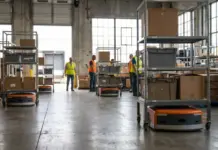
A common concern when introducing robotics in logistics is the impact on the existing workforce. However, the design philosophy behind AMRs is centered on collaboration rather than replacement. These robots are built with safety as a top priority. They are equipped with multiple redundant sensors that allow them to detect a human foot or an outstretched arm from several meters away, slowing down or stopping instantly if a collision is imminent. This “soft” interaction allows humans and robots to share the same space safely, creating a hybrid environment where each can do what they do best. Robots handle the repetitive, heavy, and boring tasks, while humans provide the dexterity, problem-solving skills, and oversight required for complex operations.
Looking ahead, the evolution of autonomous mobile robots warehousing will likely focus on even deeper integration and increased intelligence. We are already seeing the emergence of “swarm intelligence,” where a fleet of robots can communicate with each other to optimize their collective movements and avoid congestion. Furthermore, the integration of AI-driven grasping technology will allow AMRs to not only transport goods but also pick them up directly from the shelves, moving closer to the goal of a fully autonomous “lights-out” warehouse. As technology continues to advance, the distinction between different types of automation will blur, leading to a unified, intelligent, and highly responsive logistics ecosystem.
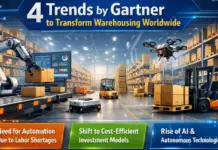
In conclusion, autonomous mobile robots are much more than just a way to move boxes. They are a fundamental tool for building a modern, resilient supply chain. By providing flexibility, scalability, and unmatched precision, AMRs are helping businesses overcome the challenges of labor shortages and rising consumer expectations. The transition to a robot-enhanced warehouse is not just about staying competitive; it’s about creating a better working environment and a more efficient world. As these warehouse automation trends continue to gain momentum, the organizations that embrace mobile robotics will be the ones that lead the way in the next era of global distribution. The transformation is already underway, and the robots are leading the charge.