





















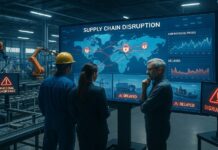

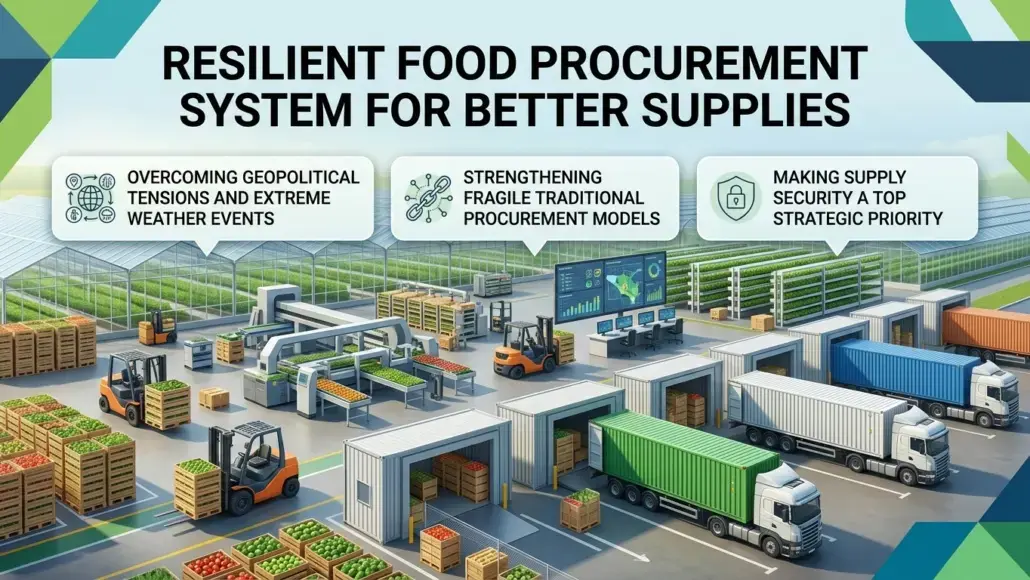
The worldwide food industry is experiencing one of the most turbulent times in contemporary history. Geopolitical tensions, extreme weather events fuelled by climate change and the continuing effects of global pandemics have highlighted the fragile nature of traditional, lean procurement models. In this setting, supply security has become a first-tier strategic problem rather than a routine tactical concern. This is where resilient food procurement system steps in – the structure that enables organizations to withstand these shocks and ensures that the flow of high-quality ingredients as well as finished products is continuous irrespective of the external pressures.
Establishing a resilient food procurement system calls for an evolutionary shift in how organizations perceive value. Cost reduction will always be a consideration, but it can no more be the only driver of buying choices. Resilience is built on agility, openness, and diversification. This means moving away from dependence on a single low-cost supplier or region to a far more networked approach which can adapt to quick shifts. By combining sophisticated procurement solutions along with digital planning tools, companies can create a procurement engine that is not just effective but also remarkably robust.
Resilient Procurement Strategy Fundamentals
The initial step to resilient food procurement is to possess a good understanding of sourcing risk. Most companies have an accurate picture of their direct, tier-1 suppliers but lack visibility into the more complex aspects of their supply chain. Tier 3 or Tier 4 risk – For example, a problem in a specific seed market or a lack of packaging materials may spread and end up affecting the entire network. To be resilient, you must map out your entire supply ecosystem and find any potential single points of breakdown. Once these hazards are determined, procurement teams may establish mitigation plans like maintaining safety stocks of essential items or pre-qualifying alternative sources.
Supplier diversification is perhaps the most essential component of a resilient procurement strategy. The old adage – don’t put all your eggs in one basket – has never been truer. Firms can protect themselves against localised disruptions by tapping into multiple regions and a variety of supplier mixes – from large industrial companies to smaller and local producers. The organization is able to transfer its volume to an alternative region if a shortage affects output in one part of the world simply because it has a diversified network. Such geographical separation is a crucial insurance policy against the growing uncertainty when it comes to global agriculture.
Collaborative Initiatives to Enhance Supplier Resilience
Resilience is more than just about having a greater number of suppliers, it’s about enjoying stronger, more cooperative relationships with those suppliers. In a conventional contractual model, a buyer may change vendors at the first sign of problems or a trivial price benefit. But a strong food procurement model envisions suppliers as long-term collaborators. Companies can support producers in order to build in-house resilience via close working relationships. This could include offering technical assistance to farmers to boost yields from crops or working together on joint investment in novel processing technology.
This partnership is enabled by digital procurement platforms. Real-time exchange of information and forecasts can help buyers as well as suppliers better coordinate their operations. For instance, if a buyer shares its long-term demand projections with the supplier, the supplier can forecast its output better, reducing the possibility of shortages or excesses. Such openness makes us trustworthy and builds the social capital that is required to get through an emergency. When something goes wrong, a supplier is much more likely to stand with a long-term partner with whom they have a powerful, data-driven bond.
Utilizing Digital Procurement for Forward Planning
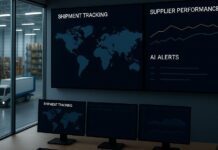
Modern resilient food procurement is based heavily on technology. Human analysts would overlook trends and hazards that digital procurement solutions can detect by analysing enormous amounts of data. For example, AI-driven tools can monitor global news, atmospheric conditions, and indicators of the economy to provide warning in advance of possible supply threats. This means that procurement groups can move from a reactive mode to a proactive mode and make improvements to their sourcing strategy prior to a crisis actually arising.
Additionally, digital procurement planning allows for scenario modelling or stress tests. For example, companies can run simulations involving various disruptive events, like the closing of a major shipping lane or an unexpected rise in energy costs, to determine how their supply chain would react. This enables the development of playbooks for various scenarios so that the organization can react with pace and assurance when unforeseen circumstances arise. In the fast-paced food industry, a capacity to make sound judgements within hours can be the distinction between maintaining the shelves stocked or having to empty them.
Efficiency & Resilience balance
One of the debates that keeps going in standard procurement is the trade-off between resilience and effectiveness. The trend for years has been the just-in-time approach, minimizing stock levels and focusing on achieving the lowest possible unit cost. This model works effectively in a stable setting, but it does not have the buffers needed to deal with fluctuations. Resilient food procurement is searching for a middle ground – a model perhaps called just-in-case which means building up strategic stocks of key components and paying a little extra to get a more stable and dependable supply.
This does not imply sacrificing efficiency. Rather, it involves using technology to attain efficiency within an environment of resilience. For instance, businesses can use savings resulting from procurement automation so as to build supplier resilience through automating routine tasks that lower their administrative expenses. Additionally, sourcing analytics can help businesses determine the total cost of risk to help with more balanced choices based on the potential impact of the interruption. In the end, a resilient supply chain is more effective in the long term as it minimises the enormous costs of stockouts, expedited delivery, and lost revenue.
Sustainability as a Key Component of Long-Term Resilience
Sustainability and resilience go hand-in-hand. A resilient supply chain, by definition, is not an ecologically degrading or socially harmful supply chain. These procedures deplete resources, trigger regulatory crackdowns, and negatively impact reputation with time, all of which compromise supply security. Resilient food procurement system incorporates ESG – Environmental, Social and Governance – criteria into the sourcing process. A company that selects suppliers who practice regenerative farming and honour their workers equitably makes an investment in the long-term health of its supply network.
Moreover, sustainability practices generally tend to improve risk management. For instance, directly promoting the future security of the supply by offering water management or heat-resistant seeds to farmers to help them adapt to climate change. With consumers and investors advocating for accountability, sustainability in procurement planning is no longer a choice. It is a fundamental requirement for any organization that seeks to guarantee its survival and success in an evolving global market.
Future Prospects of Resilient Sourcing
In the future, we will see even more advanced technologies being used to promote resilient food procurement. More advanced AI will enable real-time, autonomous adjustments to sourcing approaches, while blockchain might offer additional degrees of confidence and openness in relationships with suppliers. Or we might anticipate an upgrade to more local and regional supply chains as a strategy to reduce the hazards associated with long-haul global trade.
But the human element will continue to be the most important. The most resilient organizations will be those that establish a society of quickness, curiosity, and teamwork. Procurement professionals will have to be part data scientist, part diplomat as well as part strategic thinker. Through adopting the principles of resilient food procurement and utilising the best technology at its disposal, the food industry has the potential to help build a future in which supply security can be assured and high-quality food is accessible to all.