



























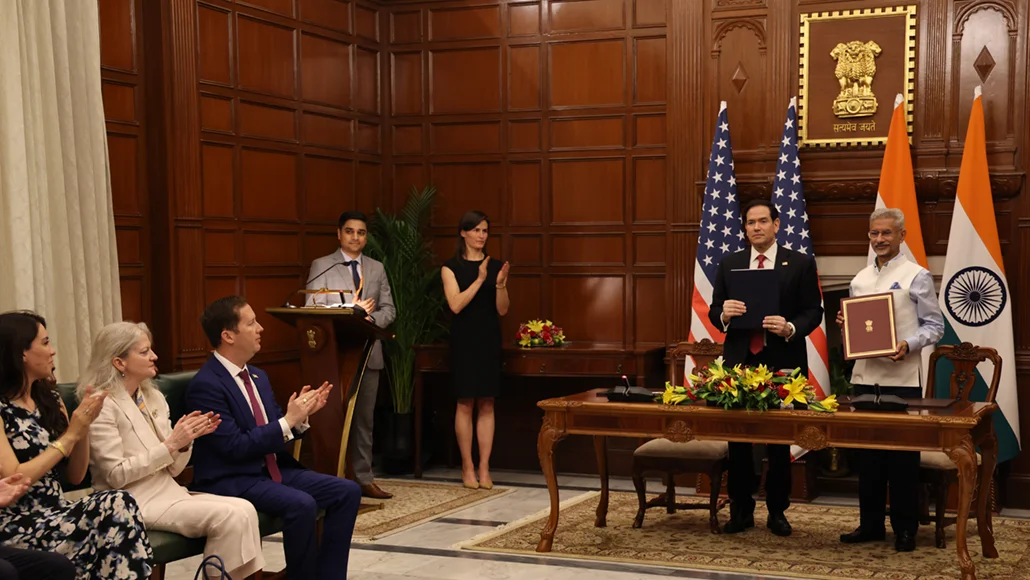
India and the US on May 26, 2026, agreed to a fundamental structure for cooperation to ensure stable supply chain of critical minerals. This decision comes in the face of rising concerns over export controls from China on rare earth elements as well as strategic metals that are critical for global technology supply chains.
The framework for the securing of supply of mining and processing of critical minerals was executed on the sidelines of the Quad foreign ministers’ meeting which was held in New Delhi.
“It is something very timely and critical,” said External Affairs Minister S. Jaishankar in the presence of Marco Rubio, US Secretary of State.
Jaishankar said that “this framework aims to deepen our cooperation across the entire critical minerals and rare earth supply chain, including mining, processing, recycling and related investment.”
According to the external affairs minister, the framework will assist to finance projects; build robust as well as diverse supply chains; and guarantee efficient handling of critical minerals as well as rare earths.
He added that “it is one more sign of how close our cooperation has been in a world where there are so many challenges but also so many opportunities. “We are two countries that have strategic interests in ensuring reliable long-term access to critical minerals and supply chains that are important for our innovation economy.”
One US statement described the agreement as a turning point in the strategic partnership between both countries to guarantee that the foundational elements needed for advanced technology and energy are accessible within dependable networks.
By using this mechanism, the United States and India will be involved in global attempts to safeguard sensitive supply chains from forceful market practices and to reduce the shared vulnerability to single-source monopolies.
The U.S. government is pulling together a staggering number of resources to safeguard stable supply chain of critical minerals in collaboration with the private sector, backing projects with over $30 billion in loans, investments, and other types of support.
These investments, together along with Pax Silica as well as the renewed diplomatic and commercial participation, are producing a multiplier effect, generating private capital many times higher than the usual government outlays, it said.
Rubio also referenced the US-backed Pax Silica initiative
“The groundwork was laid for this on February 4 when you joined us at the Critical Minerals Forum that we hosted in Washington DC,” adding it achieved traction after India agreed to sign Pax Silica.
He further added that “Today, because we both have a strategic and shared interest in the fact that vibrant innovation economies such as ours cannot afford to leave the foundational materials of these industries vulnerable to a single-source monopoly that could deny us these things, not just in a time of conflict, but as a leverage point contrary to our sovereign national interests. I’m glad we were able to sign this because in addition to being an important document and important agreement, it brings a tangible example of the strategic partnership between the US and India.”
Last December, 2025, the Pax Silica initiative was launched to establish a secure, robust, and innovative-based stable supply chain of critical minerals as well as artificial intelligence.