





















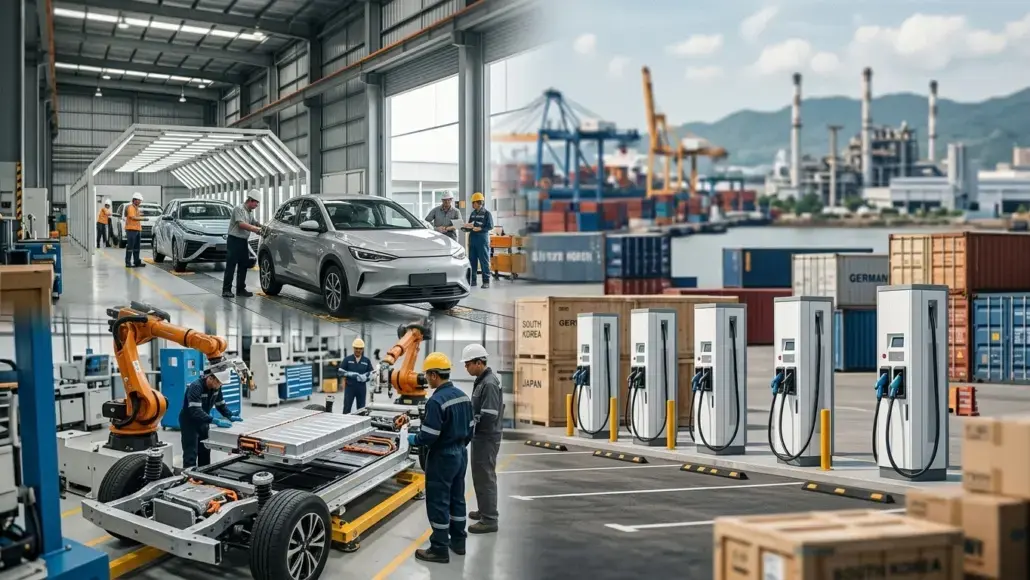
Thailand received investment pledges of over $4.1bn in EV supply chain funding comprising 198 projects for hybrid systems, battery electric vehicles, battery manufacturing, critical components as well as charging infrastructure.
The Thailand Board of Investment – BOI said in a statement on July 6, 2026, that the investment comprises the participation of manufacturers from China, South Korea, and Germany as well as Japan. The investment is divided across the supply chain.
It is well to be noted that as part of the $4.1bn in EV supply chain funding, 18 BEV projects are estimated to be worth $1.18 billion and will boost domestic yearly production capacity to over 370,000 units, including SAIC Motor, Chinese manufacturers BYD, Aion, Changan Auto, Omoda as well as Jaecoo in addition to Hyundai Mobility from South Korea and Germany’s Mercedes-Benz.
Hybrid vehicles, apparently, comprise $1.18 billion across 14 projects, relying on the legacy of Japanese automakers when it comes to hybrid technologies.
Batteries along with energy storage systems were granted $ billion throughout 57 projects so as to establish localized battery cell along with pack manufacturing. Key components like battery management systems and drive motors as well as power control units received $373 million when it comes to 49 projects.
The charging infrastructure was awarded $292 million for 42 projects that will support more than 22,900 charging stations across the country, including over 10,000 DC fast chargers of high speed.
Interestingly, in 2025, electric vehicles comprised over 40% of total new vehicle registrations in Thailand with HEVs accounting for the majority at 21.8% and BEVs coming in second place at 19.6%.
It is worth noting that Mercedes-Benz was the first to begin local production when it comes to luxury BEVs across Thailand in 2022, which was followed by a rush of Chinese competitors such as Great Wall Motor, BYD, SAIC Motor as well as Aion in 2024. Manufacturing by Changan Auto and EV Primus began in 2025, and Hyundai Mobility from South Korea and China’s Omoda and Jaecoo will ship in 2026. These investments in manufacturing resulted in over 16,000 local jobs.
The BOI has also facilitated 18 Sourcing Day events that matched over 800 Thai parts manufacturers with multinational automakers, resulting in over 1,200 business matches. These links may generate over $1.79 billion in domestic procurement value and turn traditional tier-1 and tier-2 suppliers into a high-tech EV supply chain, says the BOI.
The Secretary General of the Thailand Board of Investment, Narit Therdsteerasukdi, said that the strategy by Thailand to promote all propulsion technologies, including hybrid and plug-in hybrid as well as battery electric, enables established players and emerging competitors to invest and develop collaboratively.