





















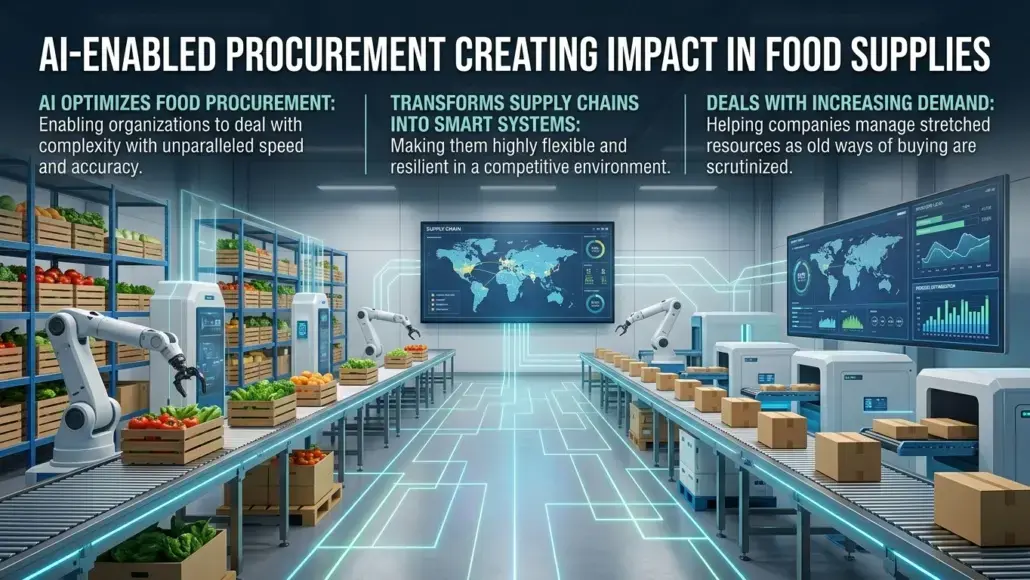
The worldwide food industry is at a turning point. With demand on increasing levels and resources stretched, the old ways of procuring and buying are being scrutinised like never before. In this type of highly competitive environment AI-enabled procurement is now recognized as a disruptive force, enabling organizations to deal with complexity with unparalleled speed and accuracy. Artificial intelligence has transformed food supply chains into smart, highly flexible and resilient systems by simplifying routine tasks, offering profound insights into supplier performance and forecasting market fluctuations.
For many years, acquiring food was an administrative process, with the goal of cost reduction through hand-to-hand bargaining and paper records. But today’s scenario demands a far more prudent strategy. Businesses are now anticipated to take a number of factors into account, such as sustainability, ethical sourcing, and geopolitical security as well as evolving consumer preferences. AI-powered procurement lets businesses deal with these factors at once and find the ideal balance between cost, quality and risk.
The change from tactical to strategic thinking is vital for all businesses that want to stay ahead of the game in the 21st-century food market.
The Emergence of Predictive Analytics and Sourcing
Predictive sourcing is one of the biggest wins for AI when it comes to the food industry. In a world where weather trends are becoming more unpredictable and global trade paths are subject to abrupt alterations, the ability to anticipate unforeseen events is highly valuable. AI procurement systems go on to evaluate historical data and real-time metrics, including satellite imagery of production of crops, reports on the economy and shipping information, to foresee possible shortages or price spikes. It gives procurement staff the opportunity to secure standard contracts or find other vendors well in advance, thereby shielding the company from the fluctuation that often characterizes the food industry.
Analytics used for sourcing are not just about tracking prevailing costs. These advanced features help you calculate the total cost associated with ownership, including logistics and storage as well as potential waste. In the food industry, where purity and freshness are of highest priority, speed frequently supersedes cost. AI-driven procurement can work these trade-offs out in seconds, giving decision-makers a clear understanding of the most optimal path forward. In addition, procurement automation opens up human professionals to work on relationship development and high-level plans, instead of getting stuck in spreadsheets, by streamlining the data collection process.
Superior Supplier Intelligence and Management Standards
Supplier management is the foundation of a successful food supply chain. But managing hundreds, or even thousands, of suppliers in many countries is a massive challenge. AI-powered procurement has made this simple with deep supplier analysis. Algorithms can examine thousands of news outlets and financial reports as well as social media feeds to track the health and credibility of a business’s supplier base. The system immediately recognises the risk if a supplier is in financial distress or involved in unethical labour conduct, thereby enabling the procurement team to take remedial action before the brand’s credibility suffers.
Furthermore, standard artificial intelligence may be applied to assess supplier performance with objective, data-driven metrics. Now companies can track their key performance indicators – KPIs – in real-time rather than depending on periodic evaluations. It covers everything ranging from on-time delivery rates to uniformity of food quality. AI-driven procurement can pinpoint high-performing partners and lead to more productive collaborations where both parties can work together in order to promote creativity as well as sustainability. This transparency fosters a culture of constant enhancement, which is essential to maintain the high standards expected of the food industry today.
Procurement Automation for Increased Efficiency
It is difficult to exaggerate the operational advantages of procurement automation. AI is able to skip the whole lifecycle from the first RFP to the last payment. Smart bots are able to take care of routine supplier queries, handle invoices with almost flawless precision, and even conduct basic negotiations for contracts based on predetermined parameters. This not only minimises the chance of human mistakes but also greatly accelerates the procurement cycle. This speed is a huge operational benefit in the fast-moving food business where interruptions can lead to food spoilage and lost sales.
Also, AI-enabled purchasing eliminates the so-called maverick spend – purchases made beyond the known contracts or protocols. They provide a smart and intuitive user interface for internal users to make sure all purchasing activities are consistent with the company’s bigger picture. This data consolidation creates a single source of truth that enables better spend analysis as well as more informed budgeting. As digital procurement tools grow more sophisticated, they will begin to employ natural language processing – NLP so as to enable users to interact with procurement systems just as effortlessly as they would with a human colleague.
Resilience Building in a Volatile Marketplace
The ultimate objective of AI-enabled procurement is to create a resilient food supply chain that is capable of withstanding the global pandemic in recent times and subsequent supply chain crises have highlighted the weaknesses of traditional lean, just-in-time models. Now the focus is on just-in-case approaches that emphasize flexibility and broad diversification. AI is the engine that makes this possible. AI procurement tools are also able to maintain a constant watch on the world scene and suggest varied sourcing strategies, so a company doesn’t lean too much on one region or supplier.
Resilience also means being able to change direction fast. If a key port closes or one crop in particular fails, an AI-driven system can instantly spot the effect on the whole network and suggest the best alternative. This responsiveness is what distinguishes a company that thrives from one that fails in a crisis. As supply chain AI keeps evolving, we will likely see further developed capabilities, such as the capacity to run simulations of various what-if situations, enabling companies to stress-test their purchasing approaches prior to a crisis even occurring.
The Human Factor in a World of AI
But whilst AI procurement offers apparent advantages, it is important to remember that the technology is a tool rather than a substitute for human judgement. The organizations that will prevail will be the ones that get the equilibrium right between the efficiency of machines and the instincts of humans. Purchasing specialists are expected to learn new skills, moving from transactional tasks to data analysis and strategic planning as well as relationship management. The human side of procurement – establishing confidence, dealing with complex ethics, comprehending the specifics of local cultures – is as important as ever.
The future of the food industry relies on our capacity to take advantage of the power of AI to build a more sustainable and reliable food system. By employing AI-enabled procurement, businesses can increase their profitability and be part of the solution to provide high-quality, ethically sourced food to all. The change to an AI-led model is a challenging process, but one that holds the prospect of a more efficient and robust future for the whole global food industry.