























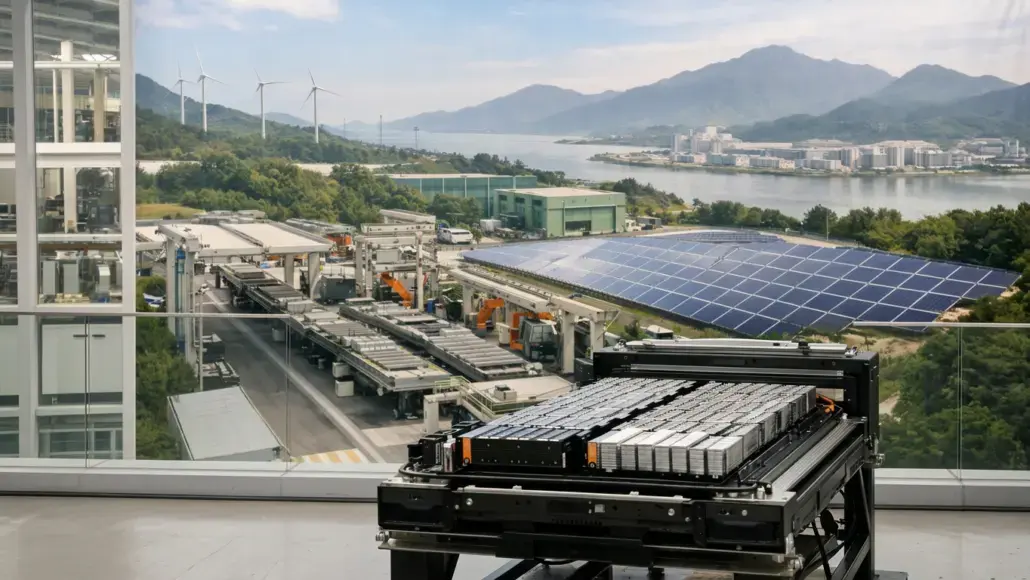
On August 17, 2026, at an event in Ningde, Fujian province, CATL announced an action plan to reach carbon neutrality in battery value chain by 2035. The battery maker also officially released outcomes on its previously announced target to achieve carbon neutrality in its primary operations by the end of 2025.
CATL’s target of carbon neutrality in battery value chain by 2035 puts less emphasis on emissions directly caused by the own operations of CATL and more on the much bigger environmental impact that comes with component production, raw materials, and transportation, as well as recycling.
Apparently, in 2023 CATL set out a two-stage plan to achieve carbon neutrality by 2025 for its core operations and by 2035 for the larger battery value chain.
The company said that by the close of 2025, 20 CATL battery plants will be certified as carbon neutral beneath the ISO 14068-1 standard. CATL considers electricity to be zero-carbon, and zero-carbon electricity was 100% of the energy utilized for its primary activities.
The carbon neutrality of core business refers to the emissions generated from the own production and business activities of CATL, mainly from the electricity consumption as well as thermal energy consumption of factories. This does not imply that emissions did not originate from those operations, but that the remaining emissions were offset with validated carbon credits shortly after reduction measures were put in place.
As per CATL, it made 748 GWh of batteries in 2025, and its lithium-ion battery sales grew 2.3 times between 2022 and 2025. At the time, the company was still the largest battery maker in the world, so greening its growing production network was a major test of whether low-carbon production procedures could be implemented at a large scale.
At the start of the program, there were few existing models in the industry to draw on, so CATL commenced with a mapping of the emissions of almost 40 battery-manufacturing procedures and a broad range of upstream materials.
In 2022, it introduced its CATL Carbon Chain management platform so as to collect and organize that data. The system now integrates battery production of CATL and other major upstream suppliers, with 1,000-plus emissions models designed for products as well as raw materials. The models are designed to help pinpoint areas where cuts in carbon can be made and to evaluate progress afterward.
The operational program of CATL was built around 6 areas, which were mainly manufacturing, factory operations, product design, supply, circularity, and zero-carbon electricity.
Since 2023, it has used over 18 terawatt-hours of electricity labelled as zero-carbon. In 2025, energy consumption per unit of battery output was down 28% from 2022, whereas carbon-emissions intensity was down about 77% in two years. CATL estimates that it has saved an aggregate of more than 10 million tonnes of carbon dioxide equivalent. The figures are based on the company’s own reporting and are different from the carbon credits it uses to offset its residual operational emissions.
CATL’s next objective runs the gamut of the battery value chain, from the extraction of minerals to the final product. CATL predicts that suppliers are responsible for over 80% of the life-cycle emissions of its products, and their overall footprint is in excess of five times that of CATL’s core operations.
That disparity is why the 2035 benchmark relies so much on changes beyond the own factories of CATL. All of the material producers, component suppliers, and logistics providers, as well as recycling companies, must play a role in order to get to the target.
CATL said its carbon-management platform is capable of tracking emissions from mineral extraction, reprocessing of raw materials, and synthesis of materials, as well as component manufacturing. It is the first carbon-data platform in the lithium-ion battery industry that has covered the entire upstream chain, says the company.
So far, calculations have been performed on operational emissions data from over 100 core tier-one suppliers on the platform. CATL uses this data to establish reduction measures in four domains mainly, material development, material production, logistics, and battery recycling.
According to CATL’s procurement director, Huang Bin, CATL wants to see emissions reductions as a way of lowering costs, transforming environmental performance into a means of commercial competitiveness.
CATL is also planning to issue a green procurement guide to integrate carbon footprints and renewable energy use along with energy consumption per unit of output into supplier qualification as well as auditing. A customized supply chain decarbonization program will involve a first batch of 30 core suppliers.
The company additionally suggested establishing a global collaborative framework for a carbon-neutral lithium-ion battery environment. The effort would seek to establish common standards, coordinate technology projects, and organize joint action throughout the industrial chain.
At the event, CATL entered into value chain cooperation agreements with cathode materials and anode materials as well as current collector suppliers. It also established strategic partnerships with the National Center for Climate Change Strategy and International Cooperation – NCSC of China and the Shanghai Environment and Energy Exchange.
The company has not specified emissions targets or short-term milestones for specific suppliers, but the contracts provide an organizational structure for the 2035 target by CATL. So, advancement depends on if its carbon-data system can deliver equivalent, auditable cutbacks throughout a geographically distributed supply chain.