




















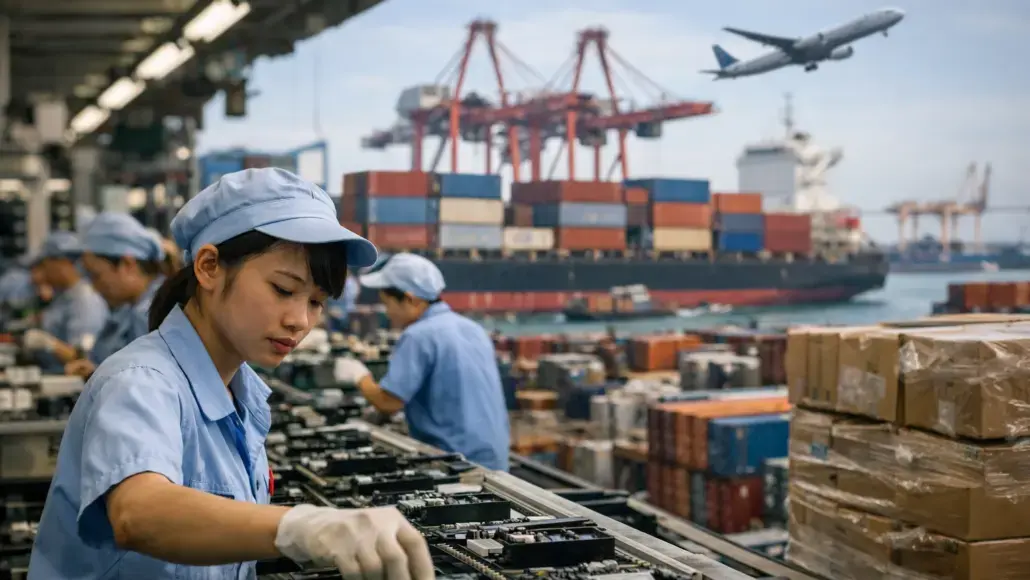
Experts at a forum in Ho Chi Minh City on August 21, 2026, said Vietnam has been deeply integrated into global supply chains, with foreign direct investment accounting for more than 80% of the export turnover in the first half of 2026.
Vietnamese manufacturing and exports are highly integrated into global supply chains, but the foreign direct investment – FDI sector accounts for more than 80% of the total export turnover at present. This was announced at a dialogue forum – Vietnam and ASEAN in the Global Value Chain: From Signals to Action that was organized by the Center for the Fourth Industrial Revolution in Ho Chi Minh City – C4IR HCMC.
At the forum, the deputy director of C4IR HCMC, Mr. Nguyen Duc Huy, said that the manufacturing and exports in Vietnam are deeply integrated into global supply chains. The FDI sector accounted for 80.1% of the total export turnover, or US$255.89 billion out of $319.53 billion in the first 7 months of 2026, an increase of 26.4%.
At this level the integration goes beyond the output stage. The manufacturing activities in Vietnam, order volumes as well as exports, are heavily dependent on imported components and raw materials, so any disruption to global supply chains can quickly affect the manufacturing activities in Vietnam and the order volumes as well as exports.
As supply chains are reconfigured, the standards for choosing suppliers by businesses have changed, Mr Huy said. Price is no longer enough to win orders. Companies need to show they can meet standards, manage data well, and deliver quickly.
This shift also offers an opportunity to improve Vietnam and ASEAN’s position when it comes to the global value chain.
ASEAN can indeed be a reliable manufacturing hub if the economies of the region can integrate their complementary advantages in manufacturing, technology, standards and workforce capabilities, said the Lead for the Regional Agenda at the World Economic Forum’s – WEF Center for Advanced Manufacturing and Supply Chains, Ms. Van Nguyen. This would go on to position the region to draw in more investment flows and also hold on to a bigger share of worth within the production chain.
To make this opportunity into real competitiveness, ASEAN needs to digitize trade flows holistically, develop a cross-border interoperable digital infrastructure and create reliable data flows, pointed out the Head of Digital Trade Policy for Asia-Pacific at the WEF, Ms Anne-Katrin Pfister.
Specifically, small and medium-sized enterprises – SMEs must be integrated into digital supply chains, which would allow them to engage more deeply and gradually raise the value that they retain in the global supply chain.