



![Busy port scene with stacked shipping containers, large cranes, and cargo ships in a bay, beside a coastal highway and rail line on the right.] }} (Note: The input requires a valid JSON with an array of strings in altTexts. Here is a corrected version.)Let's provide proper JSON.](https://www.supplychaininforms.com/wp-content/uploads/2026/09/trade-and-logistics-infrastructure-218x150.webp "Turkey Looks to Upgrade Trade and Logistics Infrastructure")




















Research Showcases Turning Point for Warehouse Digital Transformation
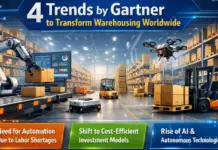
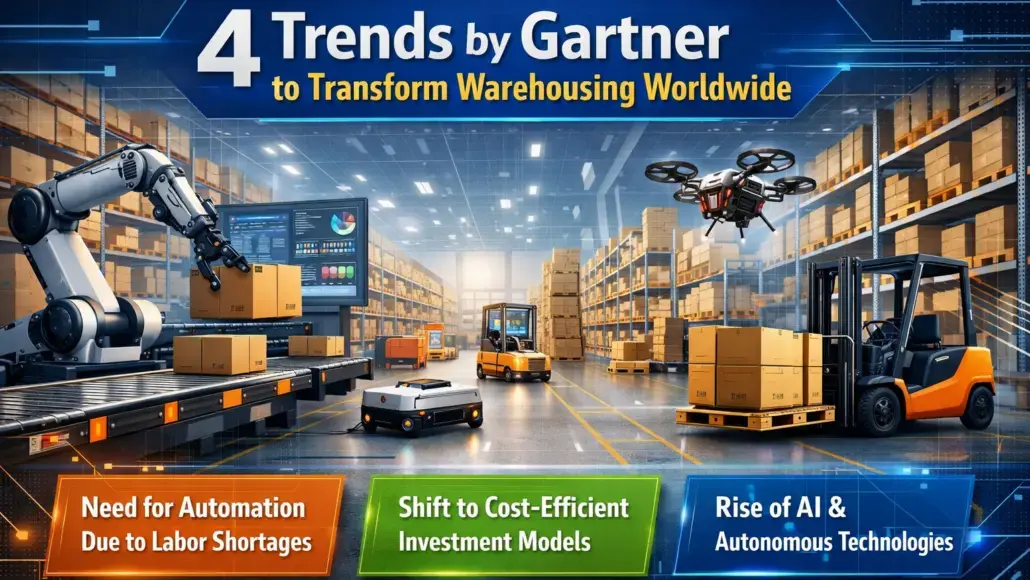
Four AI trends are poised to transform warehousing worldwide, Gartner, a business and technology insights company, says. Warehousing is at an inflection point for AI deployment, said Gartner analysts. Three converging forces are driving this change – labour constraints that make automation a mandatory requirement, capital models moving to lower-risk points of entry, and AI and autonomy technologies approaching operational maturity, said the analysts.
Gartner research identified four AI trends, each aligned to a different aspect of AI maturity and application. The key to success in the future will be striking a balance between two dimensions of AI – “action orientation” and “intelligence sophistication” and that too in the four core categories. The four trends of AI that look to transform warehousing worldwide are –
- Better traditional AI with an emphasis on optimization
- Generative AI for Operations
- Suggestive and Semi-autonomous Agents
- Embodied AI Agents
According to Senior Principal Analyst in Gartner’s Supply Chain practice, Federica Stufano, “These four AI trends are interconnected and reflect the evolution of a more intelligent, adaptive and resilient warehouse environment. As labour pressures persist and AI technologies mature, organizations are moving beyond experimentation toward operational deployment. Their success will depend on building trust through transparent AI decision-making, enabling effective collaboration between workers and intelligent systems, and applying these technologies in ways that address specific operational challenges.”
Trend 1 – Better traditional AI with an emphasis on optimization
Traditional AI is being enhanced and optimized, moving away from rule-based and statistical models and taking advantage of richer real-time data and more advanced algorithms. Modern applications of demand forecasting, labour planning, route optimization and inventory management constantly adapt to evolving warehouse requirements, improving cost savings, utilization of resources and return on investment while at the same time upholding the openness and consistency that have gone on to make traditional AI efficient when it comes to warehouse environments.
Trend 2 – Generative AI for Operations
Operational-driven generative AI applies advanced machine learning algorithms to generate practical content, strategies, and operational knowledge from unstructured and semi-structured information. These capabilities allow for the generation of dynamic standard operating processes, job instructions, exceptions when handling guidelines, and decision support tools which can be integrated directly when it comes to warehouse operations, increasing agility and facilitating faster decision-making.
Trend 3 – Suggestive and Semi-autonomous Agents
Suggestive and semiautonomous agents may close the gap between manual operations and complete autonomy by analyzing data and suggesting or partially performing multistep workflows while continuing to retain human supervision. These agents assist in enhancing assigned tasks, handling exceptions, resource allocation and operational responsiveness, thus enabling warehouse organizations to boost productivity while keeping operators engaged in critical decisions.
Trend 4 – Embodied AI Agents
Physical AI agents integrate AI with robotics and advanced sensor technologies in order to automate manual activities in warehouses. These systems can pick, pack and sort as well as handle material with high levels of accuracy and consistency, thereby boosting productivity, improving safety at work and helping organizations solve ongoing labour issues while expanding operations more effectively.
Stufano adds, “Supply chain leaders should take a pragmatic approach to AI in warehousing by tackling proven use cases, such as labour forecasting and slotting, and expanding into generative AI and agents where it can improve decision-making and workforce productivity. Maintaining human oversight while continuously evaluating new use cases will be critical to realising AI’s full potential across the supply chain.”