




![Busy port scene with stacked shipping containers, large cranes, and cargo ships in a bay, beside a coastal highway and rail line on the right.] }} (Note: The input requires a valid JSON with an array of strings in altTexts. Here is a corrected version.)Let's provide proper JSON.](https://www.supplychaininforms.com/wp-content/uploads/2026/09/trade-and-logistics-infrastructure-218x150.webp "Turkey Looks to Upgrade Trade and Logistics Infrastructure")




















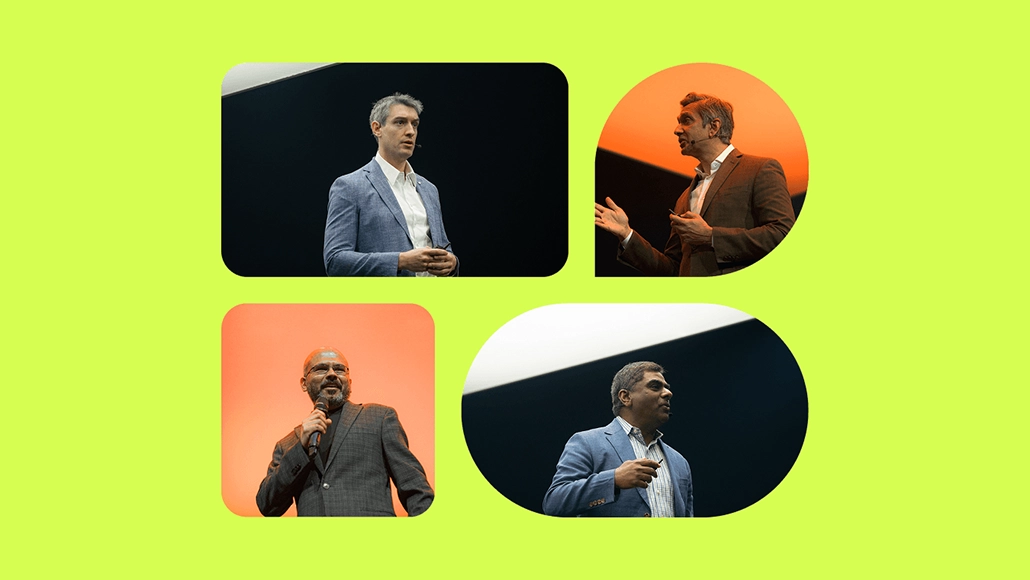
Two challenges are transforming the way every global business operates. On June 4th 2026, 10x innovation by o9 at aim10x Europe was revealed by the company built to tackle them.
The first challenge is VUCA, which is the volatility, uncertainty, and complexity as well as ambiguity that has become the enduring business climate since COVID-19.
Siloed planning along with disconnected decision-making is ineffective but acceptable in a stable world. When demand varies and supply breaks, circumstances change before the organization can respond every silo between functions becomes a prediction miss, a stock buildup, a missed service threshold, or margin erosion. Volatility does not cause the leaks, but it does worsen them, and it does that all the time.
The second problem is that fixing those leaks still takes a long time. In a large enterprise, everyone can see value bleeding away, but tackling it in the traditional way means a multi-year change program, and in a rapidly changing world, that’s a time frame no global enterprise is willing to wait for.
On top of that is the order now appearing on every executive’s desk – extract company value from AI. It does not solve them it increases the stakes. Most leaders still have no idea what the right strategy really is.
o9’s path forward was laid out in three interlinked introductory keynote sessions – APEX, its next-generation operating model, the neuro-symbolic AI that powers it and a live agentic demo addressing a real customer excess-inventory challenge.
The highlight was concept, foundation, and proof. It all began with an account about potato chips.
The Frito-Lay Story – The Silos That Led Value to Leak
If the objective is to stop the leak without the use of a multi-year program, the first step is to comprehend why enterprises leak value in the first place. Chakri Gottemukkala, Executive Chairman, CEO, and Co-Founder of o9, named one villain o9 has been after since day one, and that’s silos. And to demonstrate what a company without them would look similar to, he shared the story of Mr. Lay, the founder of what later became Frito-Lay and eventually a part of PepsiCo.
In the very beginning, Mr. Lay was a one-man, silo-free operation model. He operated the trucks, filled the shelves, spoke to consumers, and decided what to purchase, produce, freight, and rate, all by himself. The story is important because it breaks down the two things that a healthy operating model requires, and Mr. Lay had both of them by default. First, he had perfect visibility. “Perfect value chain visibility, end to end,” as Chakri put it, where every decision influenced tomorrow’s decisions. No silos for execution. Second, and equally important, “no silos in learning.” He saw a consequence of every decision and corrected it the next morning, continually, and without anybody having to call a meeting.
Then the company grew. Hundreds of brands and markets. Complex supply chains. Decision-making broken across all of it. Both of Mr. Lay’s benefits disappeared. Visibility broke into silos of execution and the automatic, daily learning into silos of learning. That is where value leakage comes from, and that is why correcting it always calls for a change – the connections Mr. Lay held in one head have to be reconstructed throughout an entire organization.

The Role of APEX in Solving Missing Learning: Visibility
The whole idea of o9 was to restore to a vast enterprise what Mr. Lay had naturally owned. The first part of the pledge is already here. The o9 Digital Brain platform, built on the patented enterprise knowledge graph technology -EKG o9 pioneered over a decade ago, reclaims end-to-end visibility, with each choice focused on one goal. Since then, many customers have created billion-dollar value cases on it. The execution-silo problem has been resolved to a significant degree.
But the second advantage of Mr. Lay, continuous learning, has not. He learned and corrected in real time, which still is rare in large enterprises. They wait for a crisis, begin a multiyear change program, and often fall back within five years. This is the learning silo, still unresolved, and it’s exactly the gap that the two megatrends make unaffordable in an unstable world fueled by AI, no company is capable of waiting for a future crisis to learn what is going wrong.
APEX is o9’s answer to the other half. If the Digital Brain could bring back the interconnected visibility that Mr. Lay once possessed, APEX is designed to bring back continuous learning and adjustment that gave visibility its value. o9’s vision of a future standard operating system that enables enterprises to sense shifts, learn every day, and turn VUCA into value.
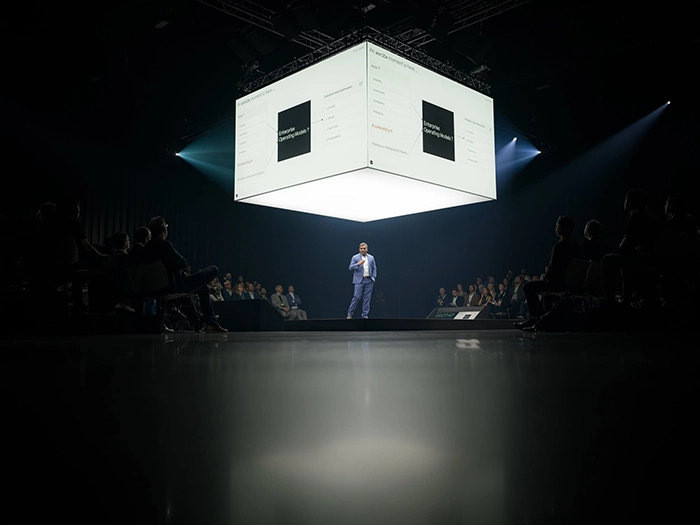
APEX stands for Agile, Adaptive, Autonomous Planning and Execution
As per Chakri, APEX is short for Agile, Adaptive, Autonomous Planning and Execution. The o9 Digital Brain already enables “Agile” through offering teams a shared, live model of the company in order to sense change, assess trade-offs as well as adjust plans quickly. The frontier is still the area of AI that redefines roles and automates decisions that’s Autonomous.
But the center of attraction at aim10x Europe was the word in the middle – Adaptive. This is the part that brings Mr. Lay’s ongoing learning at enterprise scale back in, and Chakri explained what it takes via what o9 calls the “Four W’s”: What happened? Why was that? What’s the probable outcome? What are we to do?
Most companies do a pretty good job of responding to the first question. They can see inventory building or customer service falling or margins getting squeezed. They know what has happened.

The Causal Gap that Prevents Continual Learning: Answering Why
The second question is a challenge “Adaptive” takes on – why can’t enterprises learn the way Mr. Lay did? Why was the prediction wrong? Why is margin under stress in key markets? Why did one region see a stock build-up while another saw shortages? Organizations tend to be data-rich and causally poor. They don’t get to learn from the outcomes without an explanation for why they happened, and so they are unable to change without a complete transformation in order to figure it out.
Adaptive enterprises close this gap through determining the root causes of business results. They harness these insights to constantly enhance their models, deepen their knowledge of the business, and gain knowledge from every decision. Once they comprehend why something occurred, they can answer the next query confidently – what should we do about it? Which decisions need to be evolved? What areas should be allocated standard resources? What will have the biggest effect on performance?
So “Adaptive”, continuous learning, and answering the “why” are three names for the same ability, and Chakri was adamant regarding what it takes to deliver it. Neural AI, that is, LLMs, allows us to ask and answer conventional inquiries at a rate never before seen, but it cannot explain why business outcomes happen unless it grasps how the enterprise truly works, which is the domain of symbolic AI.
The fact is that’s what o9’s enterprise knowledge graph is for. The LLM is the thinking brain the EKG is the simulation of the many systems in the body, a digital illustration of how products, consumers, vendors, factories, inventories, and constraints as well as decisions are interconnected. It gives the cause-and-effect relationships that enable AI to go from reporting symptoms to logical thinking about root causes and actions.
“Claude are unable to offer reliable health information,” Chakri said, “unless it knows precisely how the human body works.” The same concept applies to the enterprise.

Language Models Cannot Answer “Why” Alone
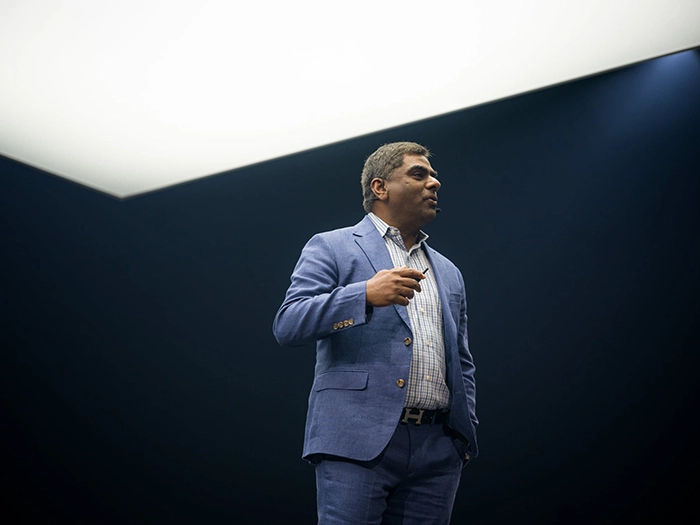
The key to continuous education is answering the “why”. But the next question to ask is, what type of AI may actually cause it? The Executive Vice President of Next-Gen AI and Technology at o9 Solutions, Dr. Ashwin Rao, picked up precisely there, clarifying why the convergence of neural as well as symbolic AI is so important to build truly flexible and adaptive as well as autonomous enterprises.
Ashwin’s view is formed by an uncommonly wide career. He had spent years on Wall Street, where the expense of an unreliable model is actual money. Previously, he was head of AI at Target Corporation. He is a visiting professor of applied mathematics at Stanford and is still doing his AI research.
That mix of trading-floor accountability, retail practicality, and rigorous math ran through his presentation. He recognized the transformative impact of large language models but provided a straightforward explanation of why language alone is not sufficient.
“Language is not total cognition,” he said. “LLMs are strong, but we need AI that goes far beyond the AI of language. That’s the AI of math and structure as well as domain knowledge.”
That gap clarifies so many disappointing enterprise AI agents. But the larger issue is dependability. LLMs are approximators, which is a benefit for scale but a disadvantage for planning. You have to be precise, you have to follow the rules and limitations, and you must uphold the decision rights individuals have in an enterprise.” A language model, no matter how powerful, is not an appropriate tool for that.

Neuro-Symbolic AI – The Power Behind Enterprise Learning
The equivalent is symbolic AI, the discipline we have been building for 15 years. It encompasses the enterprise information graph, the mathematical logic, and the decision models for stocks, pricing, and the rest. The obvious benefit to a neural network is that it can demonstrate its work. “It’s measurable, it’s audit-worthy, and it can convey things to you in straightforward business terms regarding why it reached the decision.”
Neither half alone is adequate. “The power of the neural on the left side is the weakness of the symbolic on the right, and vice versa,” he said. That mixture of symbolic AI and neural AI is known as neuro-symbolic.
Ashwin then linked the structure directly to Chakri’s “why” and Mr. Lay’s ongoing learning. The enterprise information graph doesn’t just keep records of the business, but a decision context-based graph tracks who opted for what, when, and on which data points and assumptions, and the learning layer links those choices to the outcomes they produced, progressively encoding what is effective into the rules that regulate the company.
That is the machinery that allows an enterprise to learn constantly, as Mr. Lay naturally did once, without requiring a crisis to prompt the lesson. But an architecture presented from a stage is a pledge still. The natural question is, can neuro-symbolic AI answer “why” on an actual company challenge with the traceability Ashwin described above? That was the next thing the o9 team turned to.
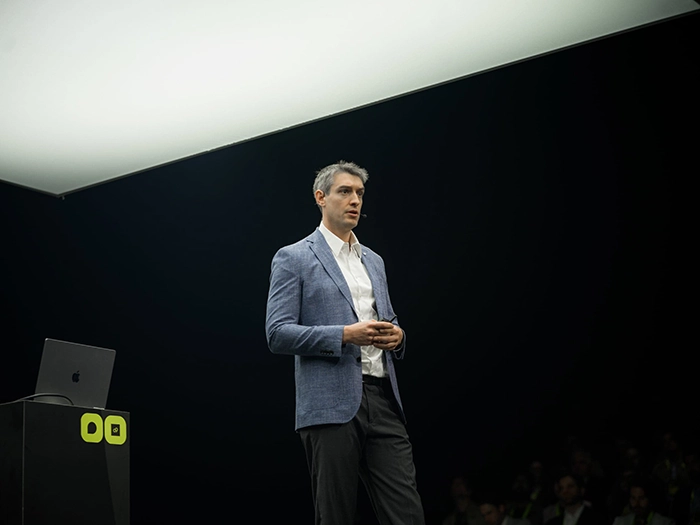
Post-Game Analysis in Practice – Identifying $60M Excess Inventory
The presentation was a post-game assessment, a technology that puts the hypothesis on screen, and it started from the gap that everything so far had been working toward. All the planning systems out there can show stock is up. But nobody can say why.” That was the introduction that SVP of Solutions Consulting at o9 Solutions, Peter Taylor, built. Planning systems are good at forecasting the future, but they do a poor job of linking decisions to results, and the post-game evaluation of today, in the shape of dashboards and advisory decks, doesn’t get to the root cause. “It’s about managing the smoke of an inventory issue,” Peter said, “but doesn’t get to dealing with where there are fires in the organization.” The outcome is politics and lack of action – too complex to diagnose and too contested to solve.
Peter shared a real surplus inventory analysis for a beverage customer. An agent generated an executive narrative on the four questions of what happened, where it occurred, why it happened, and what to do. He said that visibility alone is essential, noting $100 million in inventory savings just from combining inventory information across multiple divisions and ERPs that no one view had ever done. But the view is a one-off, the execution-silo half of the issue. The “why” is the key to creativity. The system is trained to mine the decision trail – system forecast, planner override, production order, and next override so as to answer a specific question: What decision or policy caused stock to pile up at this node? Bad forecast at DC or an output lot size set upstream at the plant a month ago? The agent then quantifies the prize, $60 million in recoverable excess inventory in the present instance, spread across demand planning, manufacturing, and purchasing, with solutions ranging from quick policy modifications to longer transformation tasks.
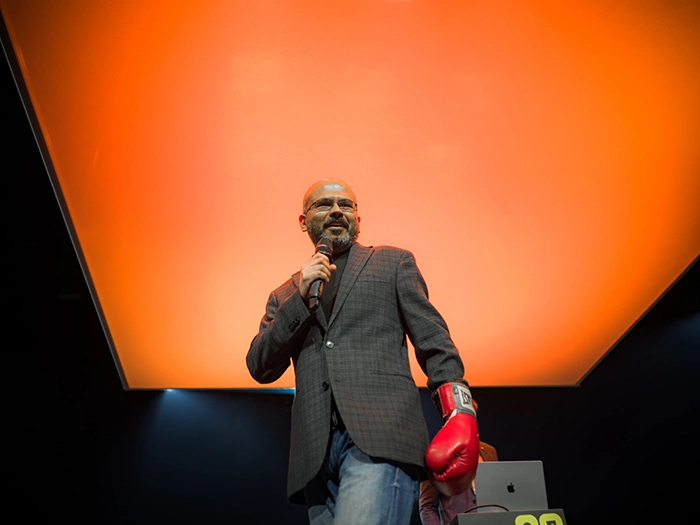
Inside the Demo – How the Agent Maps Data and Preserves Audibility
The SVP of Product Management at o9 Solutions, Nitin Goyal, then showed how the evaluation is built and how it exemplifies precisely the neuro-symbolic division, Ashwin described, with the neural front end sitting on top of the symbolic base below. A user transmits raw files, and the agent does the work of mapping them, which otherwise takes months to do, connecting the raw data to o9’s data model without any manual prep work. It looks at the data, overlays external drivers, and measures forecast quality against industry norms – in this case flagging a gap between the customer’s 30% error rate and a 22% industry benchmark before suggesting three concrete levers, beginning with removing biased overrides. You can inspect each step. “You can see the traces,” said Nitin, “so you have the trust that it is in fact employing the data and not delusional.” The auditability Ashwin assured of from symbolic AI was visible on screen.
The demo was the result of months of analysis compressed into a single minute-long session. But the more important point was not velocity. It was that “why” question that Chakri started with, the one that companies had not previously been able to reliably answer, now had a measurable, comprehensible, and ready-to-act-on response.

The Company That Never Stops Learning: From Periodic Crisis to Daily Habit
What the day that encompassed 10x innovation by o9 at aim10x Europe really claimed is simple. And it closes the circle back to where Chakri began. The obstacle in enterprise performance is no more prediction. It’s about diagnosis. And transformation. Chakri saw trouble years when a company was losing value before it comprehended why. The union of neural reach and symbolic precision meant, Ashwin explained, that the remedy was now buildable. Peter and Nitin showed how to answer the “why” on an actual balance sheet in a matter of minutes.
But underlying this is the desire Mr. Lay represented accidentally – a company that sees the whole value chain, links every decision, and acquires knowledge all the time. The difference is scale: a billion value-chain nodes instead of one person and one truck. APEX o9’s argument that finally, AI may make that enterprise real, transforming change from a periodic emergency into a daily habit, the only speed a world of uncertainty allows.