



![Busy port scene with stacked shipping containers, large cranes, and cargo ships in a bay, beside a coastal highway and rail line on the right.] }} (Note: The input requires a valid JSON with an array of strings in altTexts. Here is a corrected version.)Let's provide proper JSON.](https://www.supplychaininforms.com/wp-content/uploads/2026/09/trade-and-logistics-infrastructure-218x150.webp "Turkey Looks to Upgrade Trade and Logistics Infrastructure")

























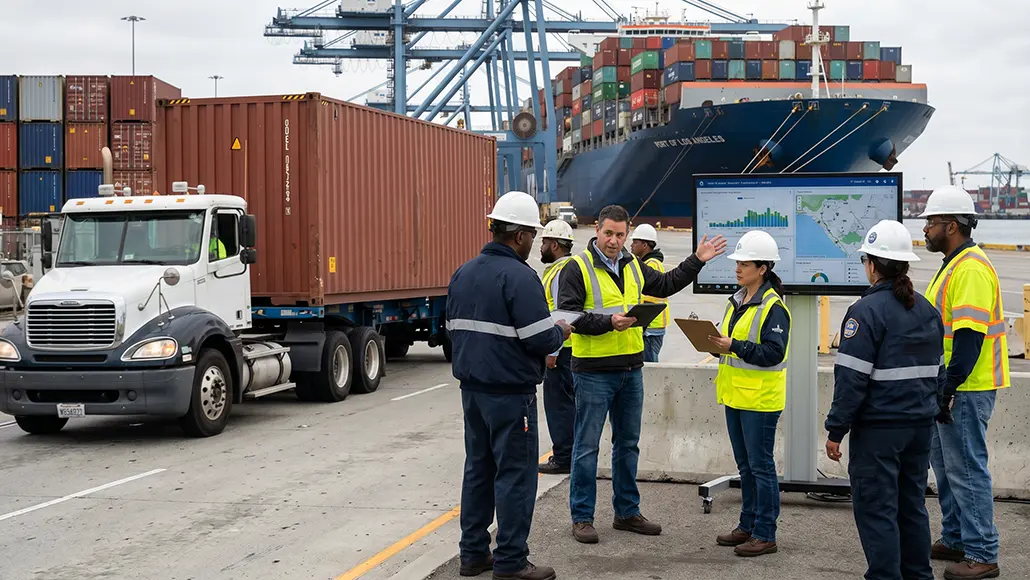
The U.S. Department of Transportation said on June 12 that it plans to launch the American Supply Chain Sovereignty Initiative in order to expedite cargo processing, minimize logistics costs and bolster the U.S. workforce, based on a press release cited by Supply Chain Dive.
The program will consist of a high-visibility dashboard that links ocean carriers, trucking companies, and railroads as well as retailers, including Walmart, to key hubs like the Port of Los Angeles, the release said.
According to Transportation Secretary Sean Duffy, fewer delays mean lower costs throughout the supply chain, and that this initiative is designed to avoid roadblocks, move freight more quickly, and provide goods at a lower price for the American people.
The American Supply Chain Sovereignty Initiative is modeled after the Freight Logistics Optimization Works program of the department, which was launched in 2022. That data-sharing platform was initially created to facilitate shipment movement after extended Covid-19-related restrictions.
The FLOW platform captures several types of data, and in 2024, the DOT began publishing data on inland freight hubs, such as rail terminal and warehouse end destinations, so as to help shippers with capacity planning and prevent delays in the supply chain. Other published data comprise purchase data as well as cargo movements from specific ports of origin.
As of April 2026, FLOW had 86 members, which included CMA CGM, PetSmart, and The Home Depot as well as GE Appliances.
The new project also builds on the National Freight Strategic Plan that was revised in 2026, according to the press release. The plan, launched in 2020, is meant to steer national policy and investment on supply chains. Duffy is now working to have the legislation needed for the American Supply Chain Sovereignty Initiative included in the 2026 National Defense Authorization Act.
The release confirmed that the Congress is providing the department the framework as well as adaptability to securely simplify national logistics by providing the U.S. Department of Transportation the ability to build role-based access to certain data points.