

![Busy port scene with stacked shipping containers, large cranes, and cargo ships in a bay, beside a coastal highway and rail line on the right.] }} (Note: The input requires a valid JSON with an array of strings in altTexts. Here is a corrected version.)Let's provide proper JSON.](https://www.supplychaininforms.com/wp-content/uploads/2026/09/trade-and-logistics-infrastructure-218x150.webp "Turkey Looks to Upgrade Trade and Logistics Infrastructure")















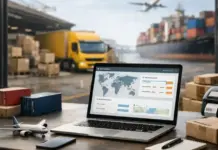
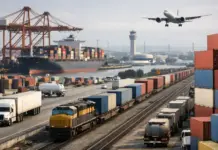

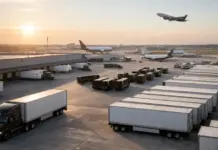
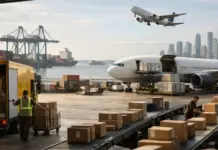





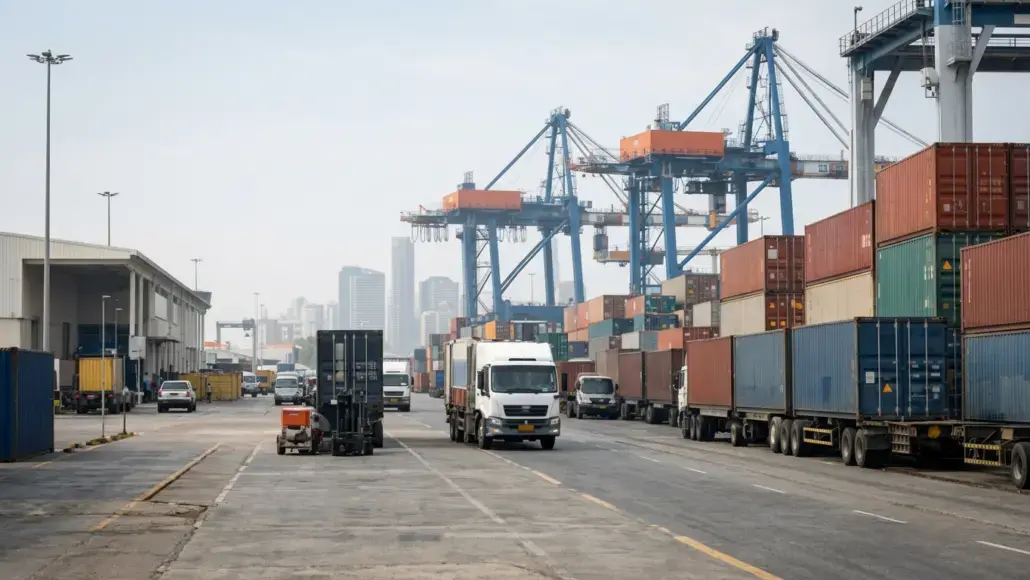
The economic ties between the United Arab Emirates and India are slowly entering a wider phase, and it is no longer just about trading goods. These days, it has become all about logistics and integrating supply chains, and cross-border infrastructure projects, as well as forging stronger investment ties.
As per the reports from Gulf Today and various other regional media, bilateral trade in the fiscal year 2025-26 went on to reach $101.25 billion. This is the second year in a row in which total trade has been over $100 billion, which truly demonstrates how fast this partnership has developed.
The two countries are targeting $200 billion in yearly trade by 2032. Reaching the target will require not only higher transaction volumes but also far smoother and more effective transportation as well as customs processes.
From Increased Trade to Complete Supply-Chain Integration
It is worth noting that the region’s coverage spotlights projects such as the Virtual Trade Corridor and Bharat Mart, as well as cooperation on the India-Middle East-Europe Economic Corridor, or IMEC, as essential elements of the larger strategy.
Apparently, all these projects intend to elevating logistics and integrating supply chains, ramp up market access, and develop new paths when it comes to trade and investment flows, such as diversifying alternatives as well as enhancing resilience.
The Effect of the Comprehensive Economic Partnership Agreement
A significant chunk of this growth was fuelled by the UAE-India Comprehensive Economic Partnership Agreement, which came into force in 2022. It was, in fact, the first of its kind for the UAE.
The talk has been that the deal opens up access for goods, services, and financial resources and also gives greater space for private sector companies across both nations. The real win for manufacturers, exporters, goods operators, and logistics providers is to reduce barriers and build a more robust policy base for procurement and distribution networks.
Cooperation between the UAE and India within BRICS
The partnership also has significant implications within the BRICS grouping. The UAE, which joined as a full member in January 2024, is also an affiliate of the New Development Bank, which gives it a more prominent role in the bloc’s economic and financial cooperation initiatives.
The 18th BRICS Summit got underway on September 12, 2026, in New Delhi under India’s presidency. The 20th anniversary of BRICS was marked with the theme – Building for Resilience, Innovation, Cooperation and Sustainability.
In this regard, the UAE-India relationship is being touted as a precedent of how trade, logistics, and investment, as well as innovation, can be tied together within a larger, more cohesive regional system.
What the Next Phase Might Mean for Business
The next level of UAE-India cooperation will likely be judged not just by headline-grabbing trade numbers but by how well businesses can take advantage of the systems being put in place. A larger trading relationship means a company must manage purchasing, manufacturing, storage, shipping, customs documentation, and final delivery throughout multiple markets.
This can give companies engaged in sourcing a better footing to evaluate suppliers and manage procurement in India and the UAE. Firms might also scrutinize the location of their warehouses, access to goods and services, and the dependability of cross-border procedures. This is important particularly for distributors, manufacturers, and retailers, as well as companies that deal with electronics or other items that require a well-managed inventory.
Logistics is yet another core element of the relationship. Good logistics can give businesses more confidence in planning shipments, whereas digital trade tools could make it easier when it comes to commercial partners so as to share documents and information.
The fact is that better coordination will not solve all problems, but it can help make transporting goods more manageable and perhaps minimize unnecessary delays.
Infrastructure is not only about ports, roads, or storage facilities. It additionally encompasses data systems, digital infrastructure, and payment links as well as communication between public agencies along with private-sector operators. When these elements are working together, companies have better insight into orders, deliveries, customs requirements, and delivery schedules.
Opportunities for Smaller Firms
Stronger economic ties could help not just big corporations. Better access to markets can also benefit smaller companies if they are familiar with the appropriate laws and efficiently use readily accessible trade channels.
Practical issues for smaller exporters might be how to find buyers, how to put together documentation, how to handle payment terms, and how to choose the right logistics provider. Service companies could also find possibilities in fields including freight coordination, storage, technology, regulatory compliance, and business support.
Development in digital commerce could bring businesses and consumers even closer together. Mobile platforms and online marketplaces, along with electronic payment methods, can help companies offer products and interact with customers more easily. But companies still have to think about product norms, delivery requirements, returns, taxation, and customer service prior to entering a new market.
These problems are relevant for a wide range of industries, right from industrial supplies to consumer goods to lifestyle products. They also apply to electronics companies, in which procurement, inventory management, certification of products, and after-sales service can all influence the effectiveness of a cross-border operation.
The importance of robustness and diversification
Businesses globally are increasingly concerned about supply-chain robustness. Most companies want reliable availability of supplies, parts, and products, as well as transportation services. UAE-India cooperation can help to diversify further by providing greater possibilities for sourcing, distribution, and accessibility to regional markets for the business community.
Diversifying does not always imply altering suppliers or routes. Instead, it may require more connections and emergency plans. Companies might look at different suppliers, ways to transport goods, places to store them, or centers to distribute them from. The aim is to be better prepared for when market dynamics shift.
For policymakers and infrastructure planners, resilience may also mean improved coordination between various modes of transportation. Links in road transport, maritime shipping, and air freight, as well as warehousing, can affect the efficiency of moving goods from point of source to point of destination. The same is true in the case of information flows, where postponements in documentation or standard communication may impact physical delivery times.
The fact is that today, the UAE-India economic relationship is much more than a mere transfer of goods. It encompasses infrastructure, investment, digital connectivity, logistics, trade policies, and regional cooperation. The target of $200 billion in annual trade by 2032 puts greater focus on the systems that facilitate commercial activity.
Whether that goal is realized will rely on ongoing cooperation and on the extent to which companies take advantage of the available networks. Better customs procedures, dependable logistics, useful digital solutions, and clear access to markets are all capable of contributing towards a more interconnected trade environment.
The primary takeaway for businesses is simple – future growth needs to be built on thorough planning all through the supply chain. Procurement decisions, transportation, technology, compliance with regulations, and customer expectations will all become more and more interconnected. The UAE and India are creating an alliance in which these components can help each other, with the possibility for new opportunities when it comes to commerce, investments, electronics, mobile trade, and wider economic activities.