

![Busy port scene with stacked shipping containers, large cranes, and cargo ships in a bay, beside a coastal highway and rail line on the right.] }} (Note: The input requires a valid JSON with an array of strings in altTexts. Here is a corrected version.)Let's provide proper JSON.](https://www.supplychaininforms.com/wp-content/uploads/2026/09/trade-and-logistics-infrastructure-218x150.webp "Turkey Looks to Upgrade Trade and Logistics Infrastructure")





















![Busy port scene with stacked shipping containers, large cranes, and cargo ships in a bay, beside a coastal highway and rail line on the right.] }} (Note: The input requires a valid JSON with an array of strings in altTexts. Here is a corrected version.)Let's provide proper JSON.](https://www.supplychaininforms.com/wp-content/uploads/2026/09/trade-and-logistics-infrastructure.webp "Trade and Logistics Infrastructure")
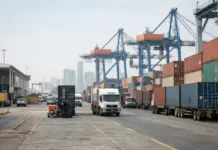
As per its Medium-Term Program – OVP for 2027-2029, Turkey is looking forward to becoming a global logistics hub connecting Asia, Europe, the Middle East as well as Africa by upgrading trade and logistics infrastructure in order to speed up transportation processes and minimize exporter costs.
It is well to be noted that the three-year economic roadmap is focused on developing alternate and dependable trade routes along Turkey’s east-west and north-south axes in the face of recent regional conflicts as well as supply chain issues.
Apparently, with this Ankara is looking to improve the capacity and competitive advantage of international transport networks, namely the Middle Corridor and the Development Road project.
Plans are underway to reinforce the links on the Baku-Tbilisi-Kars and Kars-Iğdır-Aralık-Dilucu railroad lines as well as the Zangezur Corridor. These upgrades are going to diversify and broaden rail transport capacity extending from the Caspian Basin via Türkiye to the European markets.
As part of the trade and logistics infrastructure boost, planned upgrades to the Hejaz Railway in the south will provide seamless global transport connections linking Turkey to the remainder of the Middle East.
Simultaneously, the Istanbul Northern Railway Crossing will be an important junction, providing a direct link when it comes to freight from the Middle Corridor, the Development Road, and the Persian Gulf to Europe.
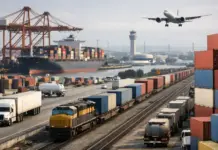
Turkey will strengthen its central role in global trade with the building of a smooth and highly capable railway connection between ports, rail lines, and roads.
The OVP describes other initiatives to strengthen ties between these corridors and logistics centers, organized industrial zones, production facilities, airports, and border crossings in an attempt to increase the proportion of rail transport in total freight transport and thus boost the intermodal transport capacity of Turkey.
These efforts will also enhance Turkey’s competitiveness in international commerce and its potential to be a global logistics hub.
Ankara seeks to enhance its international logistics distribution networks project in order to pull more domestic firms into global supply chains and create the required infrastructure to speed up and reduce the cost of end-to-end global shipments.
It is worth noting that the three-year economic roadmap also places a premium on reducing Turkey’s foreign reliance on critical inputs as well as technologies and outlines plans to build proactive intervention capacities and alternative supply chains against possible hazards caused by geopolitical instability or trade precautions.