

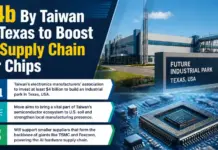


















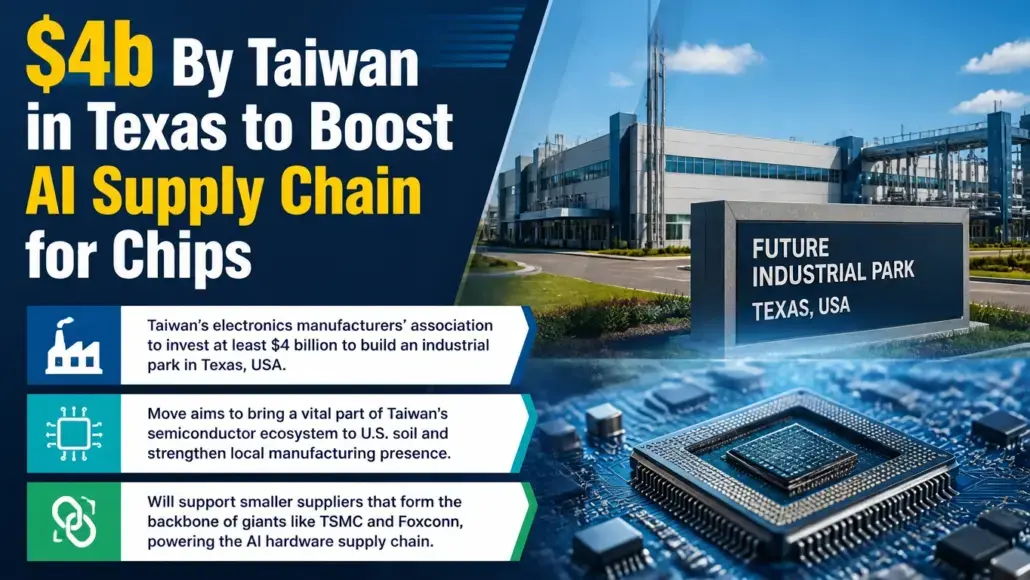
Taiwan is getting ready to generate at least $4 billion via its association of electrical and electronics manufacturers to develop an industrial park in Texas, a step to move a vital part of its semiconductor ecosystem to U.S. soil.
The move is geared to help the many smaller suppliers that form the backbone of the manufacturing giants, including Taiwan Semiconductor Manufacturing Co. and Foxconn, that dominate the artificial intelligence hardware supply chain controlled by Nvidia and others.
Says Taiwan’s Minister of Economic Affairs Kung Ming-hsin, they are going to build a long-term sustainable supply chain there, not just Taiwanese companies, but American companies and local workers can join.
The decision comes as major Taiwanese companies have already pledged huge sums of money to expansion in the U.S. TSMC has invested $165 billion on its Arizona site and has committed to spending another $100 billion on further advanced fabrication plants. Foxconn, along with Wistron, is also adding to their U.S. production capacity as the need for AI infrastructure continues to grow.
But the AI supply chain for chips depends heavily on a community of smaller manufacturers who do not have the independent financial capacity to set up shop overseas. Earlier in 2026, at a keynote in Taipei, Nvidia CEO Jensen Huang publicly recognized the vital role these smaller companies play in the global AI supply chain for chips.
To solve the issue, the Taiwanese government is working with the Taiwan Electrical and Electronic Manufacturers’ Association, which will lead the fundraising effort. The package of support goes beyond physical facilities. The government intends to provide loan assurances for companies that operate on the site and will help them work with local as well as federal U.S. officials on visas, permits, and various other regulatory paperwork.
Although Taiwan has reportedly obtained land in Texas for the project, the Ministry of Economic Affairs has not yet disclosed specific details, saying that it will provide more details on the plan at a later time. This is not just one location for the initiative, the government is looking at more than one site, and each complex would cost between $2 billion and $4 billion.
The strategy is part of a wider push to shorten the supply chain for AI semiconductors and reduce geopolitical risks from tensions with China. It also seeks to deliver on investment pledges made under Taiwan’s trade deal with Washington.
American companies are also invited to join the prospective supply chain. Terafab by Elon Musk could stand to benefit from the ecosystem, but Taiwanese companies would not hand over their core technologies for vertical integration by foreign parties, Kung added.