





























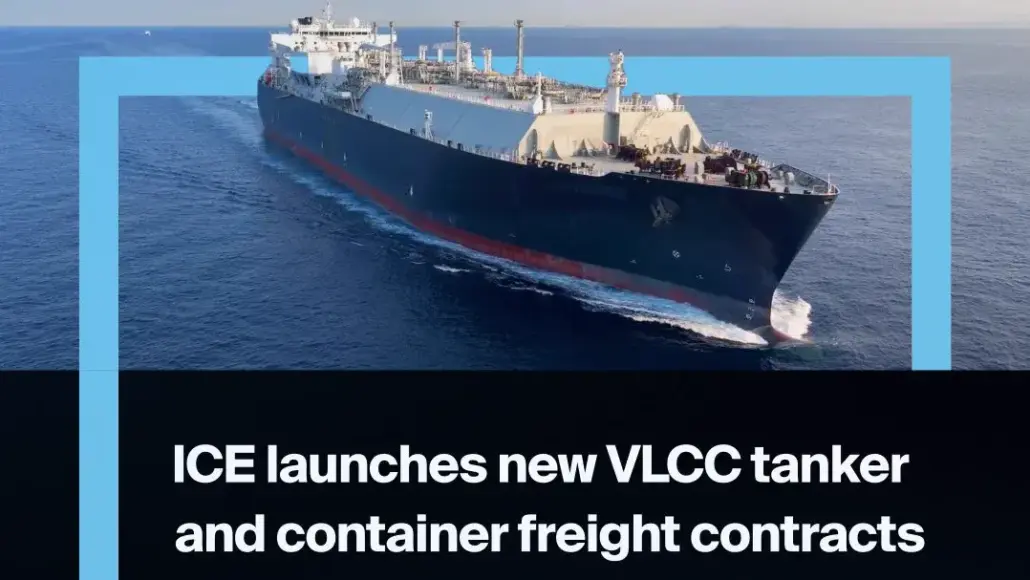
Intercontinental Exchange, Inc., – ICE which is one of the largest providers of financial market technology and data in the world and operator of the world’s largest and most liquid energy derivatives markets, announced on October 5, 2026, the introduction of new tanker and container freight futures and options, as average daily volume – ADV throughout the freight markets of ICE has increased by 33% year-to-date.
ICE on October 5, 2026, went ahead and launched the first tanker freight futures on the TD34 FFA – Gulf of Oman to China and TD15 FFA – West Africa to China Very Large Crude Carrier – VLCC routes that are cash-settled futures determined by Baltic Exchange price assessments to provide the market a further way to protect these routes as customers traverse limited access via the Strait of Hormuz.
ICE additionally introduced two cash-settled container freight average price options, FAN – Asia to North Europe along with FAW – Asia to U.S. West Coast, based on the effectiveness of the comparable freight futures ICE established in April 2026, which have been indexed to NYSHEX’s Freight Indices – NYFI. The new tanker and container freight futures and options give customers greater flexibility to control freight rate threats on two of the busiest cargo routes of the world.
New contracts take the freight portfolio of ICE to more than 90 contracts on over 30 global wet and container freight routes. ICE is part of the global energy network, along with Brent and Low Sulphur Gasoil, which price the oil barrel directly, while freight prices what it costs to transport that barrel from port to port. These contracts provide the market with additional precise tools to hedge the cost of moving cargo and manage fluctuation across global supply chains, ICE said.
The markets that are most closely watched around the world right now are the freight markets, as geopolitical events keep changing traditional trade routes, according to SVP, Global Head of Oil Markets at ICE, Jeff Barbuto. He adds, “What makes ICE’s offering so valuable is that the market can manage the full chain of risk, the commodity, and the cost of moving it in one place, as events like the disruption at the Strait of Hormuz continue to affect both. We’re seeing that play out in real time as ship owners reroute vessels, buyers shift to alternative sources of crude, and the market reprices risk across routes far from the Gulf. ICE’s new TD34 and TD15 contracts give customers direct, transparent ways to hedge Gulf of Oman-loading and West Africa-loading voyages for the first time.”
ICE’s freight contracts complement marine and high-sulphur fuel futures adopted by shipping companies around the world and its global oil indices such as Brent, the global benchmark for internationally traded crude oil, ICE Midland WTI – HOU, ICE Dubai – Platts and Low Sulphur Gasoil, the global metric for middle distillates.