















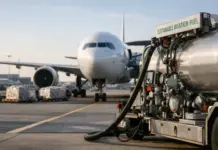






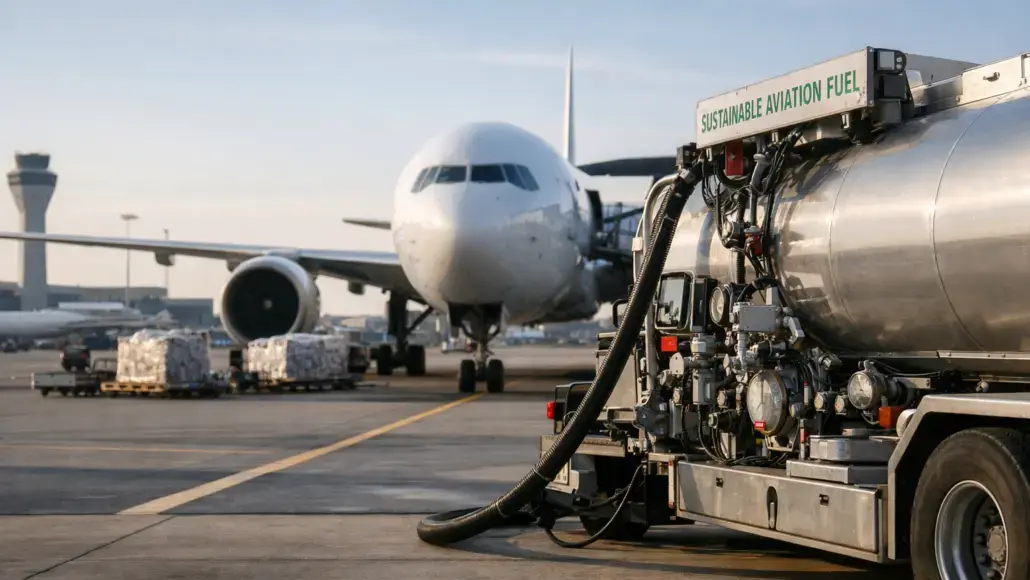
FedEx is supporting the fuelling of sustainable aviation fuel – SAF with new agreements estimated to purchase over 20mn gallons of SAF at five U.S. airports during the calendar year of 2027.
The deal to buy 20mn gallons of SAF will be implemented at FedEx facilities at Newark Liberty International Airport, Oakland International Airport, Miami International Airport, John F. Kennedy International Airport, and Dallas Fort Worth International Airport.
The agreements are expected to supply SAF in blend ratios that range from 30% to 50%, subject to location.
FedEx is moving closer to its objective of sourcing 30% of its jet fuel from blended alternative sources by the end of the decade, while increasing the use of sustainable aviation fuel – SAF throughout its U.S. air network.
As per the vice president of enterprise sourcing for FedEx, Greg Paulus, “The latest agreements represent an expansion of SAF within the FedEx air network enabled, in part, by state and federal level incentives.”
Building on a year of successful SAF use
Starting in 2025, FedEx has contracted for about five million gallons of neat SAF and has deployed 16.5 million gallons of blended SAF across five U.S. airports. With this subsequent procurement round, SAF-blended accounts for a significant portion of FedEx’s jet fuel consumption at the airports listed above.
Adds Karen Blanks Ellis, Chief Sustainability Officer and Vice President, Environmental Affairs, FedEx, “SAF is one of the most impactful decarbonisation solutions available to aviation today and an important part of our approach to reducing emissions. For the market to grow, supply needs to be reliable, affordable, and sustainable. Expanding our procurement allows us to employ more SAF in our network while bolstering the demand for greater production and scale.”
Apparently, the new deals are yet another step ahead when it comes to putting further SAF in use throughout the network which FedEx has built over the years and also demonstrate the demand which is there today. As the SAF market grows, FedEx is sure to consistently assess options so as to progress its usage where supply, infra and commercials tend to align with the requirement of its air network.
Progress from coast to coast at five major airports
This further advances FedEx’s efforts to deploy SAF. In late 2025, FedEx began using SAF at two US airports: Dallas Fort Worth International Airport and John F. Kennedy International Airport.
The two new deployments bring the total to five major US airports where FedEx will use blended SAF in 2025. Collectively these agreements secure five million gallons of neat SAF equivalent.
Says Karen, “Expanding SAF use by FedEx to include our operations at DFW and JFK caps off a successful year of SAF deployments coast-to-coast. While we know there remains work ahead to procure more SAF and to continue to educate our stakeholders about how alternative fuels fit into our overall aviation sustainability strategy, we are proud of our steps forward in 2025.”
Efficiency improvements beyond the fuel tank
In addition to increasing purchases of alternative fuels so as to power its fleet of over 700 aircraft around the globe, FedEx is also pursuing a number of other efficiency enhancement projects, including modernization of its aircraft as well as fuel savings initiatives. FedEx met its original goal to reduce aircraft emissions intensity by 30% from a 2005 baseline in FY24 and increased it to 40% by 2034.
FedEx provides a wide range of transportation and e-commerce as well as business services to customers and businesses around the globe.
The company, which turns over US$86bn a year, provides integrated business solutions through its flexible, efficient and intelligent global network.
FedEx is regularly recognised among the world’s most admired and reputable employers. With over 450,000 employees, the company is committed to safety, the highest standards of professionalism and ethics and meeting the demands of their customers and communities.
FedEx is dedicated to the responsible and resourceful global connectivity of people and possibilities with a goal to achieve carbon-neutral operations by 2040.
FedEx partnership
Hedera
FedEx has joined the Hedera Governing Council, along with Google and IBM, as well as Dell, to help manage the enterprise blockchain network with an emphasis on establishing reliable digital infrastructure when it comes to global supply chains.
OneRail
FedEx teamed up with last-mile platform OneRail to debut FedEx SameDay Local, which offers retailers two-hour and end-of-day delivery through a network of more than 1,000 drivers, serving almost 99% of the US.
Nimble
FedEx’s strategic investment in Nimble, an AI robotics and autonomous fulfilment company, will scale automation across its more than 130 FedEx Fulfilment warehouses across North America.
Amazon
Six years after parting ways, FedEx and Amazon have agreed to a fresh multi-year deal that will involve home delivery of certain larger packages and expanded free-returns options.
Aurora Innovation
FedEx has partnered with Aurora Innovation when it comes to autonomous trucking and has completed over 3,200 driverless loads on Texas routes as part of its expanded robotics collaboration strategy with Berkshire Grey, Dexterity, and Nimble.
The growing adoption of SAF across the logistics sector reflects the industry’s broader efforts to reduce aviation-related emissions. Recent developments covered by Supply Chain Informs, including DHL’s sustainable aviation fuel initiatives and its SAF solutions collaboration, highlight how logistics companies are exploring partnerships and procurement strategies to expand the use of lower-carbon aviation fuels.