

![Busy port scene with stacked shipping containers, large cranes, and cargo ships in a bay, beside a coastal highway and rail line on the right.] }} (Note: The input requires a valid JSON with an array of strings in altTexts. Here is a corrected version.)Let's provide proper JSON.](https://www.supplychaininforms.com/wp-content/uploads/2026/09/trade-and-logistics-infrastructure-218x150.webp "Turkey Looks to Upgrade Trade and Logistics Infrastructure")

















South Korea, along with the five Central Asian countries, namely, Kazakhstan, Kyrgyzstan, Tajikistan, and Turkmenistan, as well as Uzbekistan, has held its inaugural multilateral meeting of industry ministers in Seoul on September 14, 2026, agreeing to collaborate in three key domains – rare earth supply chains, industrial infrastructure, and manufacturing AI transformation.
The six countries went ahead and signed a memorandum of understanding along with a joint declaration, thereby committing to hold the meeting once every two years. When it comes to the critical minerals space, the parties will link lithium and rare earth resources from Central Asia with processing and materials technology from South Korea so as to establish a supply chain from mining to finished product manufacturing.
South Korea may as well go ahead and broaden its critical minerals procurement and grow overseas contracting for its companies, whereas, on the other hand, the five Central Asian nations can benefit from increased resource value-added and manufacturing modernization.
It is well to be noted that South Korea, along with five Central Asian countries, has formally established a multilateral cooperation framework so as to secure rare earth supply chains of critical minerals such as lithium and rare earths, along with industrial infrastructure as well as AI transformation when it comes to manufacturing.
Interestingly, the Ministry of Trade, Industry, and Energy of South Korea held the first Korea-Central Asia (C5+1) Industry Ministers’ Meeting at the Westin Josun Hotel located in Seoul on September 14, 2026. The six countries agreed on an MOU for industrial and supply chain cooperation and agreed on a joint declaration with Minister Kim Jung-kwan and the industry ministers from all five Central Asian countries – Kazakhstan, Kyrgyzstan, Tajikistan, Turkmenistan, and Uzbekistan.
It is worth noting that South Korea, along with each of the Central Asian countries, had previously set up bilateral ministerial-level consultation platforms, but this meeting is the first time they formed a multilateral consultative body that includes all five countries. The participating countries agreed to implement tangible cooperation projects in three core areas for joint response to developments in the global trade environment.
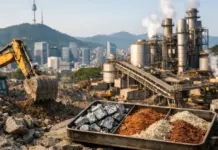
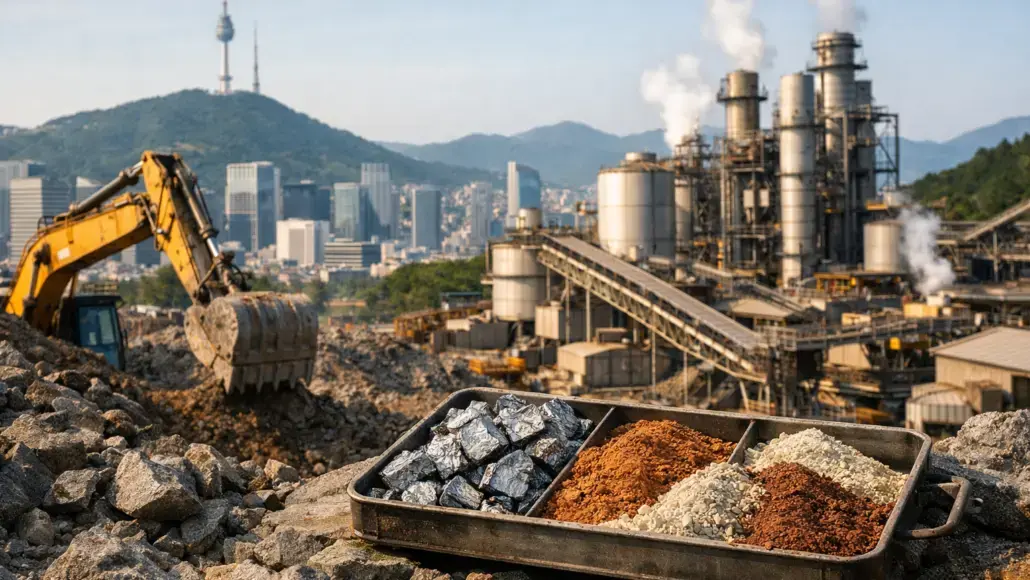
The most closely monitored area is building out a critical minerals supply chain. The vision is to integrate lithium and rare earth resources of Central Asia with South Korea’s processing and materials technology, which would lead to building an industrial ecosystem that goes beyond the basic mining to include local refining and smelting as well as high-value-added materials manufacturing.
The main goal is to foster supply chain cooperation through all its aspects, right from mining to smelting and materials processing as well as the manufacture of final products.
In the sphere of trade promotion as well as industrial infrastructure development, the parties decided to widen the involvement of South Korean companies when it comes to the development of elaborate industrial parks, establishment of smart infrastructure, and modernization of plants in the countries of Central Asia. In the spectrum of technical cooperation and talent cultivation, South Korea will utilize its smart factory and manufacturing AI capacity to help smartly modify local factories in Central Asia and boost the flow of young technical talent.
Apparently, both sides have agreed in principle to conduct the meeting on a regular basis every two years so that the advisory body will become a sustainable cooperation platform rather than just an occasional occurrence.
In his opening remarks, Minister Kim went on to say that “let us revive the pioneering spirit of the caravans that once connected Eurasia, combine Central Asia’s potential with South Korea’s manufacturing capabilities, and together open a path toward a new advanced industrial ecosystem.” In his closing statement he added, “As the Central Asian proverb goes, traveling alone makes for a long journey, but with good companions even a long road feels short. I hope this becomes a mutually beneficial cooperation platform where we build tangible projects that businesses and citizens of each country can feel.”
The fact is that this meeting is seen as a deliberate attempt by South Korea to cut itself off certain nations when it comes to critical minerals and broaden its supply sources as global supply chain reorganization accelerates. Notably, Central Asia is abundant with mineral resources that are critical for advanced sectors, including lithium, rare earths as well as uranium. However, it has long been in the orbit of influence of Russia and China, which limits the likelihood of Western and South Korean involvement.
The partnership also looks to expand raw material procurement for key industries from South Korea, such as the likes of semiconductors and batteries as well as electric vehicles, along with tapping Central Asia’s industrialization demand in order to create overseas contracting possibilities when it comes to South Korean companies in the case of plant construction, smart factories, and manufacturing AI.
The partnership allows the five Central Asian states a chance to find a technology partner in order to increase the value added of resources and encourage modernization when it comes to manufacturing.
Crucially, this cooperation is intended to establish an industrial ecosystem that includes local refining and smelting, as well as materials production, and not just sign resource import contracts.
Thus, the scope of entry for South Korean companies into Central Asia is anticipated to broaden from current mineral mining involvement to smart factory construction, plant construction, and human resource training.
The Ministry of Trade, Industry, and Energy will select particular initiatives in each of the three areas and track the status of execution by way of the biennial regular meetings. But observers do point to inadequate infrastructure, a complicated regulatory framework, and of course the impact which Russia and China have in Central Asia when it comes to the possible factors as far as the actual execution process of the project is concerned.