




























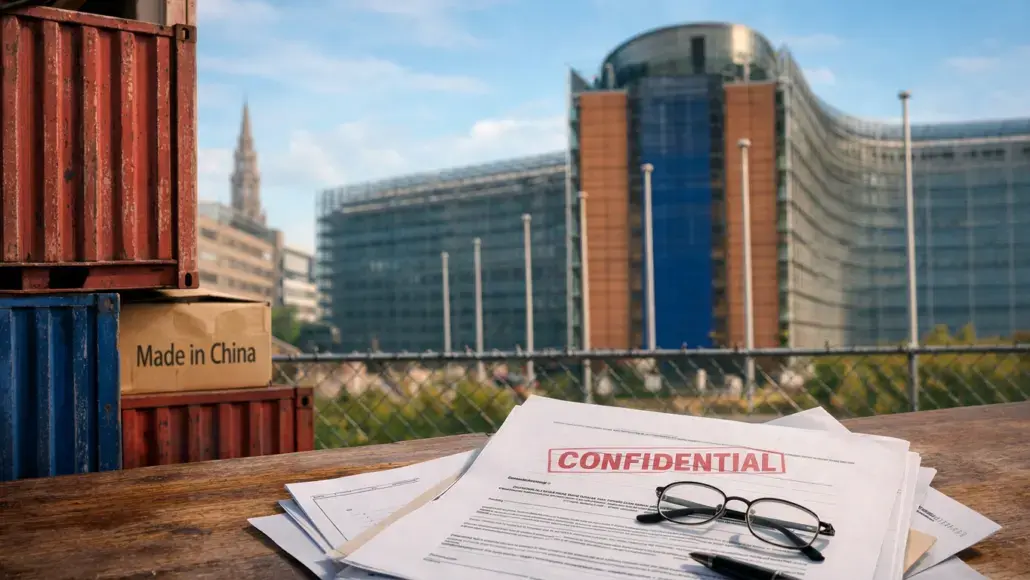
The European Commission has set up plans to allow public authorities all over the European Union to prohibit foreign suppliers from state contracts on security grounds, in a revamp of procurement law that a leaked draft suggests is aimed at decreasing the bloc’s heavy reliance on China.
The proposal, which is a single Public Procurement Act to replace the three directives regulating public purchasing since 2014, is expected to be put forward on September 9 by the Executive Vice-President of the European Commission for Prosperity and Industrial Strategy, Stéphane Séjourné.
The text looks forward to cutting what it considers to be excessive attention to pricing in tenders and to curtail detrimental strategic dependencies on suppliers from third countries, according to a draft seen by Euractiv.
It is well to be noted that the draft could still be altered before it is published.
Public buyers would have the possibility to take into account critical infrastructure and strategic supply chains, as well as key technologies, when awarding contracts, along with risks such as espionage, cyber or hybrid attacks and infringement by actors from outside the bloc.
Interestingly, apart from this, the Bidders would also have to justify prices falling substantially below competing offerings, a provision Euractiv characterised as a covert reference to China. The draft never names the country.
Interestingly, an earlier version obtained from Reuters in July 2026 provided more details of the architecture. Contracts would be given out on the basis of the best price-quality ratio, with quality criteria making up at least 30% of the total score and at least 50% for labour-intensive agreements.
But that version did not require a sweeping – buy European. However, it would enable authorities to dismiss bids for large public contracts with less than 50% European content and favour EU firms when it comes to the strategic sectors.
The fact is that the same draft went on to allow buyers to go ahead and check if a bidder’s ownership, oversight or financing arrangement posed a risk of foreign intrusion and if the company was bound by third-country laws that might require it to hand over private information.
Apparently, the new rules would be a regulation, not a directive, meaning that they would be directly enforceable in all member states without needing national enactment, thus decreasing the discretion governments have at present in the way they run the tenders.
Notably, the market in question is one of the bloc’s biggest tools of economic leverage. Public purchasing in the EU is estimated by the Commission to be worth almost €2 trillion a year.
Apparently, the reform has been prepared for a period of over one year. It was on 14 October 2025 that the Commission had gone ahead and published an assessment of the prevailing directives and on 3 November 2025 launched a consultation which closed on 26 January 2026. The adoption initially was planned for the second quarter of 2026 but then was delayed until September 2026.
Meanwhile, the trade figures have tempered the political mood. Eurostat data show that in 2025 the EU exported €199.6 billion worth of goods to China and imported €559.4 billion, resulting in a deficit of €359.8 billion. Exports fell 6.5% from a year ago, while imports rose 6.4%.
The fact is that the gap has only gotten bigger. Eurostat says the goods trade deficit of the EU with China stood at €98 billion in the first quarter of 2026, which, by the way, is the highest quarterly figure since the third quarter of 2022.
It is worth noting that Séjourné who is on a key position of Executive Vice-President of the European Commission for Prosperity and Industrial Strategy has been one of the more vocal members of the Commission when it comes to this subject. Speaking after a summit of trade ministers in Brussels on May 22, 2026, he had gone ahead and warned that few European companies had moved to further diversify their supply chains and that companies should not at all rely on just one country when it comes to all critical inputs.
It is well to be noted that procurement has already been used as a weapon against Beijing. In June 2025, the Commission vetoed bids by Chinese companies for medical devices worth more than €5m in EU government tenders. This apparently happened to be the first move under the International Procurement Instrument, highlighting the long-standing omission of European suppliers from Chinese public contracts. Notably, the EU medical devices market is worth about €150 billion.
The Foreign Subsidies Regulation, which came into force in 2023, already requires companies to go on to report money received from non-EU governments when submitting bids for contracts worth more than €250 million.
Beijing has always portrayed such actions as protectionism. Chinese state-run media Global Times reported that the revamp of procurement law is expected to increase costs for European public bodies but only provide short-term protection from competition for domestic firms.
The point is that the proposal is not law and is unlikely to become law for the immediate time to come. The text has a transition period, so it would not be applicable immediately upon entry into force. It must be approved by the European Parliament as well as the Council of the European Union according to the ordinary legislative procedure.
The file is most likely to expose familiar divisions. Italy, the Netherlands and Lithuania have called for new instruments to cut dependency on China, involving tariffs and import quotas along with supply chain regulations, while other capitals cautioned that shutting out low-cost suppliers will result in taxpayers paying more for medical facilities and railways as well as digital systems.