































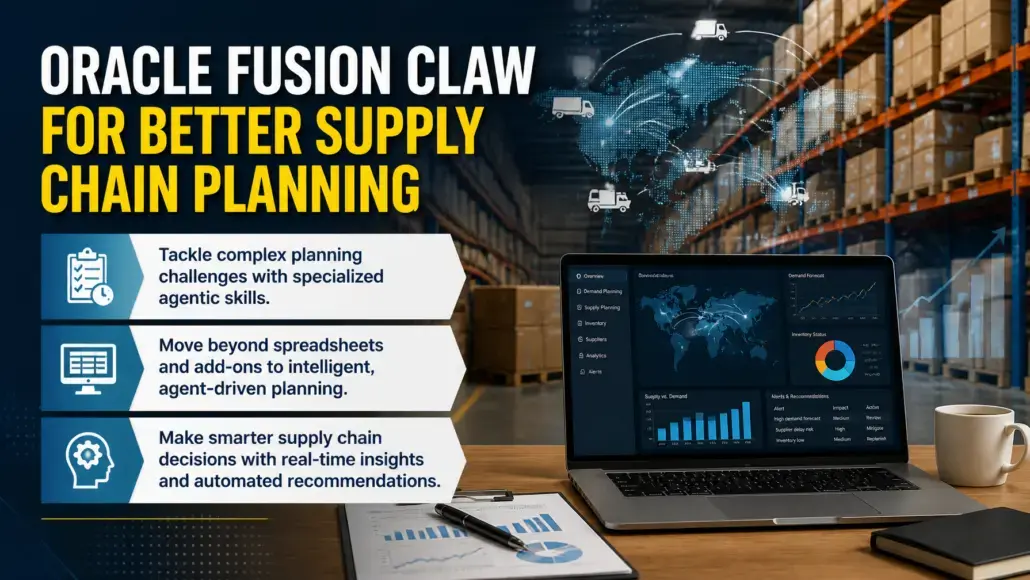
All businesses have complicated challenges that need specialist skills. Imagine a nurse administrator trying to create a staffing timetable, balancing qualifications, availability, labour rules, and overtime. Or a supply chain planner modelling limitations and options based on thousands of variables. In the past, specialists have done this type of work by employing a combination of enterprise applications and spreadsheets as well as add-on tools.
Oracle Fusion Agentic Applications began changing the way specialists operate by organising their tasks to accomplish a business outcome. Oracle Fusion Claw broadens this feature to more elaborate, long-running tasks, like creating a complex staffing timetable or an inventory plan. It enables Fusion Agentic Applications to operate on large data sets, adapt plans with changing conditions, and take authorized actions within the boundaries set by the business for what the application can do. Let us cover how Fusion Claw operates, the governance behind it and how it can be leveraged in finance, HR, supply chain and the front office.
How Fusion Claw handles complicated work
Oracle Fusion Claw is a managed execution runtime that combines AI reasoning with deterministic computation to allow Fusion Agentic Applications to handle multi-step, large data sets and dynamic conditions in enterprise-scale work. The AI reasoning part uses an advanced large language model – LLM to understand the goal, analyze the issue, evaluate options, and create a strategy. Deterministic computation then takes over the repetitive part – the computations, reconciling transactions and models on large sets of data. This two-part strategy can lower costs by using AI only for the parts of the work that require reasoning, while large-scale, repetitive tasks are handled by high-performance computing.
Oracle Fusion Claw, when it starts its work to get to an outcome, can adjust the plan as conditions change without the user having to be involved at every step. There’s continuity between runs, too. Fusion Claw retains the context of the work done so far, enabling similar tasks to build on previous results.
More freedom within the limits set by the business
As Fusion Claw becomes more autonomous, a critical question emerges – what is it permitted to do? Oracle’s answer is an architecture which separates the AI logic layer from the authority and execution-based layers. This prevents the LLM from granting itself extra permissions. A second boundary separates the deterministic execution in a secure, temporary environment, such that the LLM cannot access – and thus interfere with – the fundamental data and system of record.
Here is a high-level summary of how the governance functions
- An Enterprise Operating Envelope defines the goals, guidelines, standard operating procedures – SOPs, authorisations, approval standards and escalation points as decided by organizations. This is the layer of authority that establishes the boundaries of the work.
- An Outcome Trust Harness is used to impose those controls at runtime – in the isolated setting. It dictates what data and capabilities Fusion Claw is allowed to use, what it can do, and when it needs approval or escalation.
- The Outcome Receipt is an auditable record of the result when the work is completed. It shows the evidence utilised, decisions that were made, actions taken and transactions that were affected.
Organizations also determine the level of autonomy each Fusion Agentic Application will have. They can demand approval before things are done. They can let Fusion Claw do its thing, and people can step in or direct things as they see fit. Or they can do things entirely on their own, within certain permissions and controls. The business dictates the boundaries in each case, not the LLM.
Fusion Claw in action across the business
With Release 26D, Oracle is launching 25 Fusion Agentic Applications powered by Claw. These are examples of how they work across the business –
- Ledger Workspace can help finance close preparedness by resolving large volumes of accounting records, examining irregularities, and applying a deterministic computation to advanced accounting work.
- In HR, the Workforce Operations Command Center can build staffing plans that balance service needs with skills, availability, schedules, labour rules, and costs.
- The Shipment Load Planning Workspace in the supply chain helps in reducing shipping costs by comparing various consolidation alternatives and carrying out the plan upon authorization.
- In sales, the Account Territory Growth Plan can be used to help distribute opportunities by reviewing territory setups and account coverage.
From suggestions to results
Fusion Claw enables Fusion Agentic Applications to handle more complex, long-running tasks in order to realize business outcomes. Objectives and controls remain established by people, but more of the specialised work can be given over to the application according to those boundaries. For Fusion Apps customers, the chance is to look at routine tasks that take a lot of effort to research, plan and carry through. Then work out where Fusion Claw could take on more of that work but still have people in charge.