

























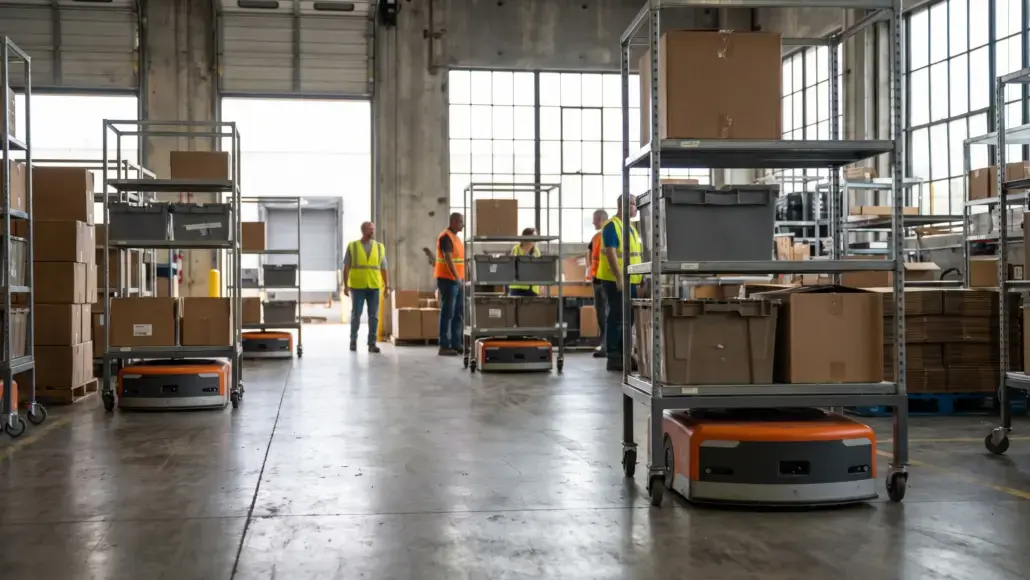
The rise of global e-commerce has fundamentally changed the expectations of the modern consumer, turning speed and accuracy into the primary currencies of retail success. In this environment, the traditional warehouse fulfillment center once a place of slow, manual sorting and bulk storage has been forced to evolve into a high-velocity engine of commerce. The primary catalyst for this transformation has been the deployment of Autonomous Mobile Robots for Warehouse Fulfillment. These intelligent, self-navigating units are doing more than just moving items they are reshaping the entire fulfillment architecture, allowing businesses to process thousands of unique orders with a level of precision and speed that was once physically impossible for a manual workforce to achieve.
Fulfillment is the “moment of truth” in the supply chain, where the digital promise made on a website is converted into a physical product in a customer’s hand. Any friction in this process whether it is a delay in picking, a packing error, or a bottleneck at the loading dock directly impacts the customer experience. Autonomous Mobile Robots for Warehouse Fulfillment address these points of friction by automating the flow of materials through the facility. By replacing manual carts and fixed conveyors with a flexible fleet of robots, warehouses can now operate with a level of fluidity and scalability that is essential for surviving the “Amazon effect” and maintaining a competitive edge in a crowded market.
Optimizing the “Click-to-Ship” Cycle Time
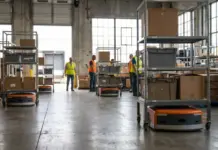
The most critical metric in modern fulfillment is cycle time the duration from the moment a customer clicks “buy” to the moment the package leaves the shipping dock. Every minute spent in this cycle is a cost to the business and a potential delay for the customer. Autonomous Mobile Robots for Warehouse Fulfillment significantly reduce cycle times by streamlining the most time-consuming part of the process: the retrieval of items from storage. By bringing the goods directly to the pickers or by guiding pickers through the most efficient routes, AMRs eliminate the “dead time” associated with manual walking. This allows for a much faster transition from order receipt to order ready.
Furthermore, the integration of AMRs with real-time order management systems allows for a more dynamic fulfillment process. In a traditional setting, orders are often processed in large batches, which can lead to delays for late-arriving but urgent shipments. With a robotic fleet, the system can practice “wave-less” fulfillment, where orders are released to the floor as they come in. The robots can be instantly rerouted to prioritize high-priority shipments, ensuring that “next-day” or “same-day” delivery promises are consistently met. This operational velocity is what allows businesses to scale their fulfillment capabilities without needing to build larger, more expensive facilities.
Scaling for Peak Demand and Seasonal Fluctuations
One of the greatest challenges for any fulfillment operation is managing the dramatic peaks in demand that occur during holiday seasons or major promotional events. Historically, this required massive hiring surges, which brought with them the costs of recruitment, training, and the inevitable drop in productivity as new workers learned the ropes. Autonomous Mobile Robots for Warehouse Fulfillment offer a more elegant and scalable solution. Because the robots are modular and easy to deploy, a company can rapidly increase its capacity by adding more units to its existing fleet. Many providers now offer “Robotics as a Service” (RaaS), allowing businesses to scale their robotic workforce up for a few months and then scale it back down when demand returns to normal.
This ability to “flex” the operation is a game-changer for financial planning and risk management. Instead of carrying the fixed costs of a massive automation system year-round, businesses can align their operational expenses directly with their revenue. Moreover, the predictability of robotic performance ensures that throughput remains consistent even during the busiest periods. A robot doesn’t get tired during an 18-hour shift, and its accuracy doesn’t decline under pressure. This reliability is the foundation of a resilient fulfillment strategy, ensuring that the business can fulfill its promises to the customer even when the volume is at its highest.
Improving Space Utilization and Micro-Fulfillment
As urbanization continues to increase, the demand for fulfillment centers located close to major population hubs has grown. However, real estate in these areas is incredibly expensive and space is limited. Autonomous Mobile Robots for Warehouse Fulfillment are helping to solve this problem by enabling higher storage density and more efficient space utilization. Because AMRs can navigate narrow aisles and operate in compact environments that would be difficult for human workers or traditional forklifts, they allow businesses to pack more inventory into a smaller footprint. This makes the concept of “micro-fulfillment” small, automated centers located within cities a viable and highly efficient reality.
In a micro-fulfillment center, every square foot must be maximized. The flexibility of AMRs allows for creative storage solutions, such as high-density racking where robots retrieve bins from deep within the system. This allows businesses to keep their most popular products just miles away from their customers, drastically reducing delivery times and transportation costs. By reshaping the physical layout of the warehouse to be more compact and robot-friendly, AMRs are enabling a new model of localized, high-speed fulfillment that is essential for the future of urban commerce. The warehouse of the future is not a sprawling suburban complex, but a dense, intelligent hub located right where the demand is.
Enhancing Quality Control and Reducing Return Rates
In the world of e-commerce, a fulfillment error is more than just a mistake it is a significant financial burden. The cost of processing a return, restocking the item, and reshipping the correct one can often exceed the profit margin of the original sale. Autonomous Mobile Robots for Warehouse Fulfillment contribute to a “zero-defect” fulfillment process by providing multiple layers of automated verification. When a robot assists a picker, it can use built-in scanners, scales, and cameras to verify that the correct item has been selected and placed in the correct container. If a discrepancy is detected, the robot flags it immediately, preventing the error from moving down the line.
This focus on quality control extends to the packing and shipping stages as well. AMRs can transport orders to specific packing stations based on the type of packaging required, ensuring that fragile items are handled with extra care. By providing a continuous audit trail of every item’s movement through the facility, the robotic system ensures total transparency and accountability. This level of precision leads to significantly lower return rates and higher customer satisfaction. In an era where online reviews can make or break a brand, the ability to deliver the right product in perfect condition every time is an invaluable asset.
The Role of Orchestration and Data Analytics
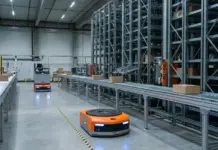
The true power of Autonomous Mobile Robots for Warehouse Fulfillment is realized through the sophisticated orchestration software that manages the fleet. This software acts as the “air traffic controller” for the warehouse, coordinating the movements of dozens or hundreds of robots to ensure they don’t interfere with each other or with human workers. The orchestration layer analyzes real-time data to identify the best paths, the best tasks, and the best timing for every movement. This ensures that the warehouse is always operating at its peak theoretical capacity, with no idle robots and no congested aisles.
Beyond immediate coordination, the data generated by the robotic fleet provides deep insights into the fulfillment process. Management can see exactly which SKUs are moving the fastest, which zones are most efficient, and where there are opportunities for further optimization. This “big data” approach to fulfillment allows for continuous, evidence-based improvement. For example, if the data shows that certain items are frequently ordered together, the system can suggest re-slotting them next to each other to further reduce picking times. By turning fulfillment into a measurable and predictable science, AMRs are providing businesses with the tools they need to achieve operational excellence.
Future Perspectives: The Path to Total Fulfillment Autonomy
The evolution of Autonomous Mobile Robots for Warehouse Fulfillment is moving toward a state of total autonomy, where the entire process from receiving a container at the dock to loading a delivery van at the other end is handled by a coordinated system of robots. We are already seeing the integration of AMRs with autonomous forklifts for pallet movement and robotic arms for piece picking. As these different forms of automation become more interconnected, the need for human intervention in the physical movement of goods will continue to decline.
This doesn’t mean that humans will be absent from the fulfillment center. Instead, the roles of warehouse workers will shift toward system management, maintenance, and high-level problem solving. The fulfillment center of the future will be a high-tech environment where humans and robots work together in a seamless digital ecosystem. The reshaping of fulfillment by AMRs is not just a technological change it is a fundamental shift in the global economy, making the world smaller and more connected by ensuring that any product can be delivered to any doorstep with unprecedented speed and efficiency.
In conclusion, the deployment of Autonomous Mobile Robots for Warehouse Fulfillment is a strategic imperative for any business looking to thrive in the modern era of e-commerce. By addressing the core challenges of speed, scale, and accuracy, these robots are enabling a level of performance that was once the stuff of science fiction. From reducing cycle times and managing peak demand to enabling micro-fulfillment and enhancing quality control, the benefits are transformative. As the technology continues to mature, the role of the AMR will only become more central, serving as the intelligent and tireless heart of a global fulfillment network that powers the modern world.