






























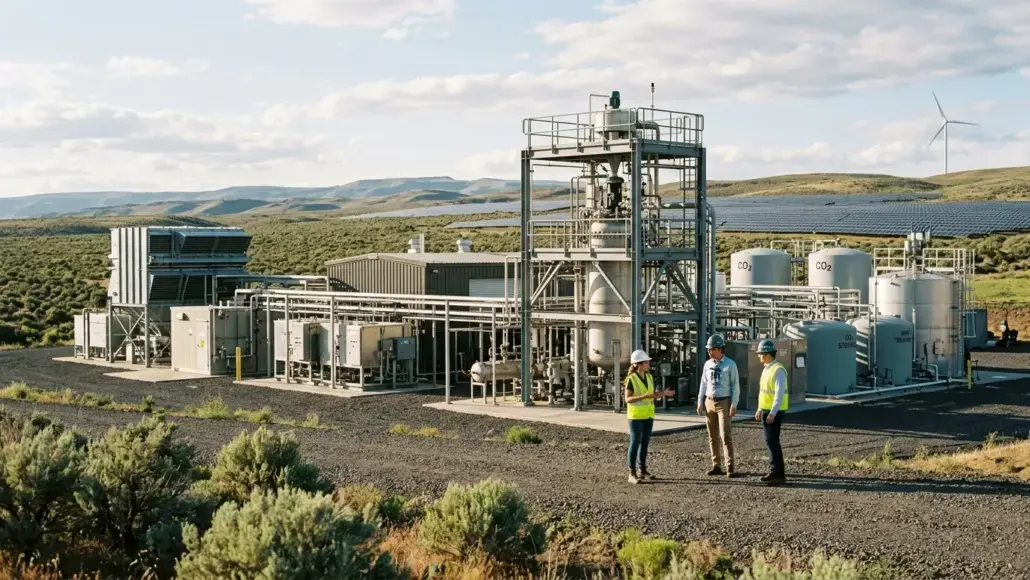
The collaboration between Microsoft, Alaska Airlines as well as industrial firm Twelve has laid the foundation for the launch of a commercial-scale synthetic e-fuel plant located in Washington state.
The facility could as well show how corporate procurement strategies can help emerging clean technology suppliers obtain project finance.
AirPlant One in Moses Lake makes low-carbon jet fuel from captured carbon dioxide and water along with renewable electricity. The fuel has a maximum of 90% lower lifecycle CO₂ emissions compared to conventional jet fuel, says Twelve.
The synthetic aviation fuel is a simple drop-in replacement for present-day aircraft and infrastructure. It complies with technical requirements and does not necessitate changes to existing aviation systems.
Supply commitments lower supplier risk
Microsoft and Alaska Airlines signed contracts in 2022 to buy the plant’s future fuel output prior to construction began. This offtake agreement de-risked the project for Twelve and obtained the financing to build out the facility.
The investment arm of Alaska Airlines, Alaska Star Ventures, is one of the investors in the $645 million round of funding by Twelve. Microsoft also contributed via its Climate Innovation Fund.
The procurement structure might reveal how large corporate buyers facilitate access for the suppliers to capital markets for infrastructure projects. Apparently, new technologies that don’t have clear signals for demand are a challenge for traditional project finance models.
Corporate travel emissions – two-fold benefits
Microsoft says the investments will help cut emissions from its business travel operations. According to Chief Sustainability Officer at Microsoft, Melanie Nakagawa, progress when it comes to climate and sustainability completely depends on partnerships such as this. She adds, “Our investment in Twelve helps scale energy solutions while laying the groundwork for cleaner aviation at a global scale. We look forward to sourcing future gallons of Washington-produced SAF to help reduce our business travel emissions.”
Interestingly, Alaska Airlines, in cooperation with Microsoft, will continue to operate scheduled domestic flights on AirPlant One’s E-jet fuel.
Reasons for supply chain diversification
As per managing director of sustainability for Alaska Airlines, Ryan Spies, partnerships like this show how collaboration can scale sustainable aviation fuel while also creating jobs, increasing supply chain diversification, and bolstering energy security. He adds that “As Seattle’s hometown airline, we are committed to supporting in-state production of sustainable aviation fuel, which is currently the best technology for the airline industry to reach net-zero carbon emissions.”
It is worth noting that domestic production location can mitigate exposure to global supply chain disruptions. AirPlant One is also a supplier of sustainable jet fuel to certain other commercial aviation partners.
Energy purchasing to keep prices stable
Twelve says the plant could provide airlines a more stable pricing structure compared to traditional jet fuel. The costs are calculated using long-term power purchase agreements for renewable energy that is used in the manufacturing process.
Traditional jet fuel is still tied to the ups and downs of the crude oil market. The alternative pricing model could be attractive to procurement teams who are looking for cost predictability.
Says Nicholas Flanders, co-founder and CEO of Twelve, “We broke ground on AirPlant One with a simple thesis: that the fuels powering the global economy could be made from renewable electricity and air, anywhere in the world.”
The plant also produces E-Naphtha, an e-Chemical produced from CO₂, water as well as renewable energy. E-Naphtha can be used to replace conventional feedstock in products like plastics, solvents, packaging, and synthetic fibres.
Mercedes-Benz, PANGAIA, and Procter & Gamble are among the manufacturers to have used E-Naphtha solutions by Twelve.