


![Busy port scene with stacked shipping containers, large cranes, and cargo ships in a bay, beside a coastal highway and rail line on the right.] }} (Note: The input requires a valid JSON with an array of strings in altTexts. Here is a corrected version.)Let's provide proper JSON.](https://www.supplychaininforms.com/wp-content/uploads/2026/09/trade-and-logistics-infrastructure-218x150.webp "Turkey Looks to Upgrade Trade and Logistics Infrastructure")














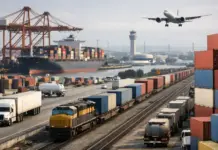




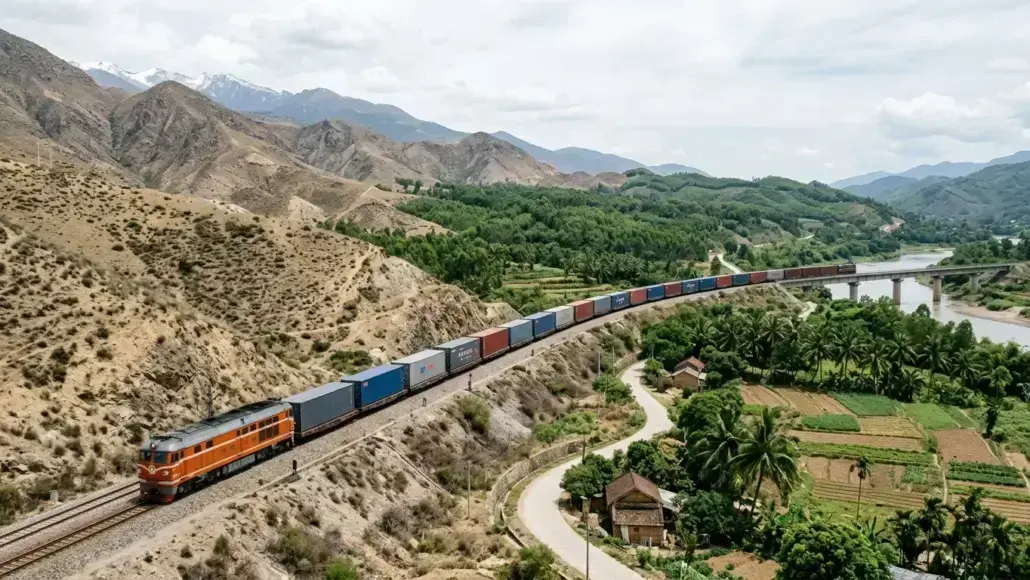
China has put into operation its first international freight train service connecting the Qinghai Province of western China and Dong Nai City of Vietnam, a move to boost regional trade connectivity.
The first train transported 1,000 tonnes of PVC plastic and travelled almost 4,000 kilometres – 2,178 km in China and over 1,700 km in Vietnam. The route started from Shuangzhai station in Qinghai, went through Yen Vien in Hanoi and finished at Trang Bom in Dong Nai.
The Importance of Strategy
This first international freight train service connects a direct container railway linking inland western China with Vietnam’s fast-growing industrial hub. The route cuts transit time from the previous 12-15 days to approximately 7 days, substantially reducing shipping costs and enhancing overall supply chain efficiency.
Industry experts view the corridor as a backbone of the wider China-ASEAN transport network that could alter the flow of goods between the two.
Teamwork Behind the Launch
The initiative was co-organised by the Qinghai Provincial Department of Commerce, Qinghai Tibet Railway and Vietnam Railways Corporation. The launch closely follows previous leadership agreements between China and Vietnam in 2026, reflecting a common commitment to deeper economic collaboration.
The service will also support broader regional economic integration and hopes to build supply chain resilience for firms operating across both countries.
Effect on Trade and Industry
The first shipment was mostly PVC resin, but the service is likely to grow to include textiles, agricultural products, machinery and electronics in the near future.
Industries that would benefit the most from the reduced transit times are those dependent on rapid logistics such as electronics manufacturing, chemicals and perishable goods. Furthermore, rail transport produces fewer carbon emissions than road or air freight, addressing the increasing demand for sustainable trade practices.
Plans for Regional Expansion
Dong Nai, already a major manufacturing hub for electronics, auto parts, textiles and plastics, happens to be a major export hub of Vietnam. With the new rail link in place, there are plans to extend goods services further into Cambodia, Laos and other neighbouring countries. This would in effect create a trans-ASEAN goods network.
The service is expanding rapidly, with a second Suzhou train to be added in mid-June 2026.
Market Responses
Vietnamese businesses welcomed the development, saying it had improved export competitiveness and strengthened the resilience of supply chains. At the same time, Chinese exporters are finding new opportunities to diversify their logistics routes and deepen their access to ASEAN markets.
The better connectivity is also expected to bring new investment into warehousing, customs facilities and distribution centres along the route.
Wider context
The launch is part of China’s growing freight rail network under the Belt and Road Initiative. It enhances China-ASEAN trade ties, improves logistics efficiency and lays an important foundation for future regional rail freight services.
The development is a significant step forward in regional trade integration – cutting costs and delivery times and creating new industrial and investment opportunities for businesses on both sides of the border.