




![Busy port scene with stacked shipping containers, large cranes, and cargo ships in a bay, beside a coastal highway and rail line on the right.] }} (Note: The input requires a valid JSON with an array of strings in altTexts. Here is a corrected version.)Let's provide proper JSON.](https://www.supplychaininforms.com/wp-content/uploads/2026/09/trade-and-logistics-infrastructure-218x150.webp "Turkey Looks to Upgrade Trade and Logistics Infrastructure")


























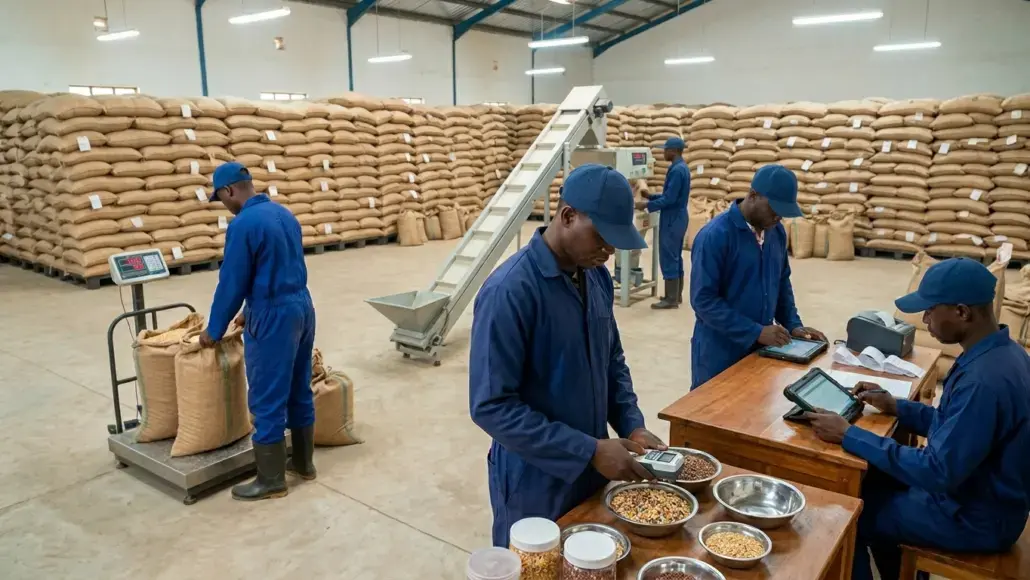
Ethiopia and Nigeria have entered into a partnership agreement to collaborate on warehouse receipt financing system, that enables farmers and traders to utilise stored crops as collateral for loans.
The deal, inked on May 7, 2026, by the Ethiopia Commodity Exchange – ECX and Nigeria’s Incentive-Based Risk Sharing System for Agricultural Lending – NIRSAL, also encompasses wider collaboration on agricultural finance and commodity trade, a statement from ECX said.
What is it all about?
Under the warehouse receipt financing system, producers as well as traders can deposit crops in approved warehouses and get a digital receipt. The receipt may be utilised as collateral to get loans for agricultural activities. It additionally enables holders to hold off on sales until the market conditions are more favourable, rather than selling right after harvest when prices are typically weaker.
The mechanism also gives traders and processors accessibility to higher-quality products and could potentially enhance market rivalry and price discovery, the United Nations Conference on Trade and Development – UNCTAD said.
The partnership could potentially modernize the commodity exchange system and the warehouse receipt financing services and, in the process, promote more open, more liquid, and more effective markets in both the countries, said Mergia Bayissa, ECX Director General.
The partnership is projected to help Nigeria tap the expertise of Ethiopia on the system.
As per the head of the Nigerian delegation, Sa’ad Hamidu, “This cooperation will facilitate the sharing of specialized expertise and create new opportunities for market development and bilateral trade.”
The warehouse receipt system has been functioning in Ethiopia for some years. Ethiopia’s Ministry of Trade and Regional Integration – MoTRI said the mechanism has made it possible for 141 farming communities to access 2.2 billion birr, or $14 million, in loans against 55,316 tonnes of produce as collateral between 2020 and 2025.
But in Nigeria the framework is still in its primary stage. In 2025, the country achieved a significant milestone when it enacted the Investment and Securities Act – ISA 2025 – that recognises warehouse receipts as monetary instruments and puts the system under scrutiny of the Securities and Exchange Commission.
Agricultural financing system spreading in West Africa
A number of West African countries are carrying out the system ahead of Nigeria. The warehouse receipt system has already been in place in Côte d’Ivoire since 2018. In 2025, the Warehouse Receipt System Regulatory Authority – ARRE of the country issued 982 receipts backed by 26,404 tonnes of agricultural commodities, in contrast to a single receipt for 34.6 tonnes when the system was launched.
Local media reported that among the commodities stored were strategic products like raw and processed cashew nuts, maize and kola nuts.
In Senegal, the warehouse receipt system was launched by the government in 2017 by means of a law that provided the legal framework. The law also established the Warehouse Receipt System Regulatory Body – ORSRE under the aegis of the Ministry of Trade and SMEs so as to supervise the operations of the system.