


![Busy port scene with stacked shipping containers, large cranes, and cargo ships in a bay, beside a coastal highway and rail line on the right.] }} (Note: The input requires a valid JSON with an array of strings in altTexts. Here is a corrected version.)Let's provide proper JSON.](https://www.supplychaininforms.com/wp-content/uploads/2026/09/trade-and-logistics-infrastructure-218x150.webp "Turkey Looks to Upgrade Trade and Logistics Infrastructure")
















C.H. Robinson is indeed the global leader when it comes to Lean AI supply chains, having created the first AI tech constantly assessing global supply chains, but at the same time, is also able to continually measure and improve its performance.
Now supporting the company’s 4PL Managed Solutions customers, a new Lean AI Engineer operates in collaboration with the Lean AI Planner launched in 2025 so as to create one connected system that distinctively improves a supply chain as it operates.
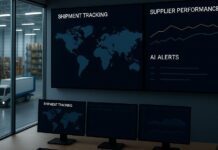
Unlike supply chain evaluations, which typically take almost four weeks and look backward at what has happened rather than what should happen, this AI tech constantly assessing global supply chains can evaluate a whole supply chain in 25 to 30 minutes and find enhancements before performance is affected. The Lean AI Engineer provides the intel, and the Lean AI Planner manages shipments with a large number of interconnected AI agents and sends more data back to the Lean AI Engineer in order to engineer smarter refinements.
According to Jordan Kass, president of Managed Solutions, the breakthrough here is that it’s one closed-loop AI system. “It will run continuously, improve the operation it’s running, and heal itself when something breaks without an alert or a human noticing a problem first. The Lean AI Planner executes in real time while the Lean AI Engineer studies the results, identifies patterns, adapts logic, and influences future decisions. Just like we launched Managed Solutions to break down the barriers between TMS, 3PL, and 4PL services, this technology ends the need for separate supply chain intelligence and orchestration tools. It’s what businesses with complex logistics have wanted for decades.”
It is well to be noted that the technology is self-sufficiently managing 92% of 4PL shipments worldwide through trucking, ocean, air as well as rail, right from order creation via tendering, exceptions, routing, delivery, and carrier payment.
Kass adds that “this level of premium logistics service has traditionally depended on talented people to manage complexity, make smart decisions day to day, and intervene during disruption,” said Kass. “The problem was that talent didn’t scale. We’ve changed that by encoding expertise in the technology itself. Shippers will get infinite talent and expertise, consistently applied across every shipment, regardless of who’s available in what time zone or how much their shipping volume grows or spikes. Their team and our team can focus on strategic priorities and driving the best business results.”
Like all AI, the success depends on what data and context the system is given access to. C.H. Robinson’s AI includes a proprietary context layer, created by systematically taking institutional knowledge from workflows and the company’s veteran freight experts and then adding it to the model on a continuous basis through the efforts of 450 in-house software engineers along with data scientists.
Kass further says that “Our technology truly understands your supply chain from the inside out, because the AI leverages all the data on all the steps of your shipping end-to-end, not just the parts of your supply chain that disparate tools see. “It also has the benefit of being trained on the unique context we have from orchestrating your freight – the large and small details about your goods, your procedures, each pickup and delivery location, your carriers, your routing, and risk tolerance. That’s how the lean AI Engineer knows which improvements are right for you, instead of making generic or theoretical recommendations. If you’re an auto-parts maker shipping cross-border to a just-in-time assembly line five days a week, it won’t suggest how much you could save by shipping once a week.”
Apparently, the advanced AI by C.H. Robinson looks at more variables than human analysis or standard software analysis, and the suggestions are more practical and prioritized. A lean AI Engineer finds optimizations and hidden savings at launch. One early adopter found that converting from a mixed shipping routine to once a week would lower their loads by 17% throughout 20 locations for yearly savings of more than $1 million. Or they could consolidate their shipments to reduce their loads by 81% and save 40% by having one pickup take care of three different delivery locations.
Lean AI Engineer will be rolling out to more customers in the weeks to come and will start to evaluate a variety of other factors, like carrier performance. It will track carrier behavior in real time throughout lanes, methods of transport, and customers, spotting leading indicators of poor performance and suggesting corrective measures prior to service failures occurring.
Says Chief Strategy and Innovation Officer Arun Rajan, “Supply chains do not generally suffer from a lack of information. They suffer from the gap between knowing and doing. “Tech that sits above or outside of a supply chain can aggregate data, harmonize signals, and recommend. But it relies on someone else to execute on the signals and someone else to learn whether those actions worked. Our tech closes the gap, delivering 24/7 premium service with one unified system no one else can match.”