

























Almost 30 years ago, Amazon took an opportunity to show that quick, dependable delivery was more than a bonus – it was the soul of a great shopping experience for customers.
To win that bet, Amazon set out to build what would eventually become one of the most dependable and effective supply chains on Earth, right from freight that moves cargo across air, land, and sea, to fulfilment centers that pick and put together millions of orders a day, to a parcel shipping network which delivers packages every day of the week. It needed a long-term mindset, leading-edge technology and an unrelenting focus on successful execution.
This story might ring a bell. Another big product Amazon created was cloud infrastructure for an identical reason – to run its own business better. And then Amazon began selling it. That’s how Amazon Web Services – AWS – emerged, and it’s transformed the way the world builds and executes software. Now Amazon is ready to do that for the supply chain as well.
Amazon has now announced Amazon Supply Chain Services – ASCS – bringing Amazon’s full suite of freight, distribution, fulfilment and parcel shipping offerings to businesses of all types and sizes, not solely Amazon sellers. This will go a long way towards helping companies in industries like healthcare, automotive, and manufacturing as well as retail, while further developing Amazon’s third-party logistics capacity.
According to Peter Larsen, vice president of Amazon Supply Chain Services, “Amazon is bringing the infrastructure, intelligence, and scale of its supply chain services proven over decades to businesses everywhere, much like Amazon Web Services did for cloud computing. Supply chain wasn’t just a function at Amazon it was core to providing an exceptional shopping experience. Our differentiator. The reason we could offer fast, dependable delivery that nobody else could. And with the launch of ASCS, we’re confident we can give any other business access to the same cost efficiency, reliability, and speed that we’ve built for Amazon customers.”
Amazon selling partner validation of the model
Its own selling partners helped prove that Amazon’s logistics network could work for others. Since 2006, independent sellers have sent out in excess of 80 billion units using Fulfillment by Amazon – FBA. Sellers came to Amazon because doing their own order fulfilment – picking, packing, shipping, as well as handling returns – was functionally intense and costly. With FBA, they could leave that work to Amazon and concentrate on building their businesses. It was successful.
Yet Amazon knew fulfilment was only part of the problem. The first place was complicated too, transporting goods to Amazon’s warehouses from factories abroad, through customs, stored in bulk, and distributed through multiple sales channels. Each one of those steps was a different supplier, a different contract, and a very limited view of what was going on with their products.
So Amazon kept building to assist sellers in addressing those issues, adding novel features at every step of the supply chain, then integrating them into an entirely automated set of services that transport sellers’ products from factory to customer doorstep by means of a single network. Today Amazon assists hundreds of thousands of sellers, shipping billions of items around the world every year. End-to-end solutions are enabling sellers to see almost 20% higher sales.
According to the founder of Finer Form, Todd Bairstow, “Amazon has added value at every stage of our supply chain from cross-border logistics to warehouse storage and parcel shipping. “We’ve been able to save money and eliminate operational complexity, and it’s given us more time to focus on what matters: building our brand. Honestly, there wouldn’t be a Finer Form without Amazon.”
The success with vendors was a natural next step for Amazon to start offering individual logistics solutions to all kinds of retail, wholesale and commercial businesses. For the past three years, a large number of Amazon sellers have relied on the company’s standard logistics system to ship, store, and distribute a huge number of packages through third-party facilities, warehouses and sales channels outside of the Amazon store. And these results provided Amazon the confidence to go more and offer these same services regardless of the kind of business.
How Amazon Supply Chain Services can help your business?
Whether you are a small retailer seeking ways to expand your customer base on the Amazon store or a multinational manufacturer seeking ways to effectively transport raw materials to manufacturing plants, ASCS gives you the freedom to select the services and level of assistance you need.
Today they went on to announce –
- Procter & Gamble is utilizing Amazon’s freight services to ship raw materials to manufacturing facilities and finished goods via its distribution network.
- 3M is leveraging Amazon’s freight services to ship products from its manufacturing sites to distribution centers all over the globe.
- Lands’ End is making use of a shared inventory pool within Amazon’s network so as to fulfil orders through multiple sales channels.
- American Eagle Outfitters, Inc. is leveraging Amazon’s parcel shipping network in order to ship orders placed online from its American Eagle as well as Aerie website straight to customers across the country.
Remarks CEO of Lands’ End, Andrew McLean, “Amazon is one of our key e-commerce partners, and we’re excited to leverage Amazon Supply Chain Services to position inventory closer to customers so we can reach them even faster. This consistency is central to our solutions-based approach, enabling us to serve customers with confidence and agility, especially during peak seasons.”
What makes ASCS different is not a single service – it is the capability, speed, and dependability that are built-in in every offer.
Main offerings include –
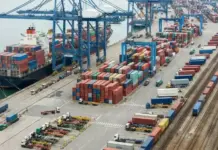
- Freight – Amazon’s transport network consists of ocean, air, and ground as well as rail freight, which is designed to help businesses ship goods quickly and securely at scale. Amazon offers accurate capacity and a variety of speeds and service choices, including time-sensitive shipments, streamlined booking, clearance at customs and end-to-end shipment visibility.
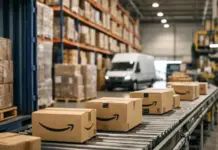
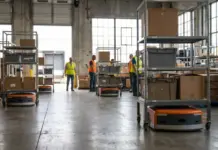
- Distribution and Fulfilment – Amazon helps businesses import and store as well as position inventory closer to demand and fulfil customer orders throughout their sales channels, all in a single network. Businesses may enhance delivery speed and precision on their own website, online marketplaces, and social media channels, along with physical stores, by leveraging a single inventory database and advanced forecasting capabilities.
- Parcel Shipping – Amazon offers a variety of standard shipping options for orders placed across all channels via reliable two- to five-day delivery and seven-day-a-week service. Businesses may choose up flexibly from their personal warehouses or third-party providers while monitoring their shipments right from label creation to the customer’s doorstep.
Now, the businesses have a central console to view, choose, and register for different ASCS options.