















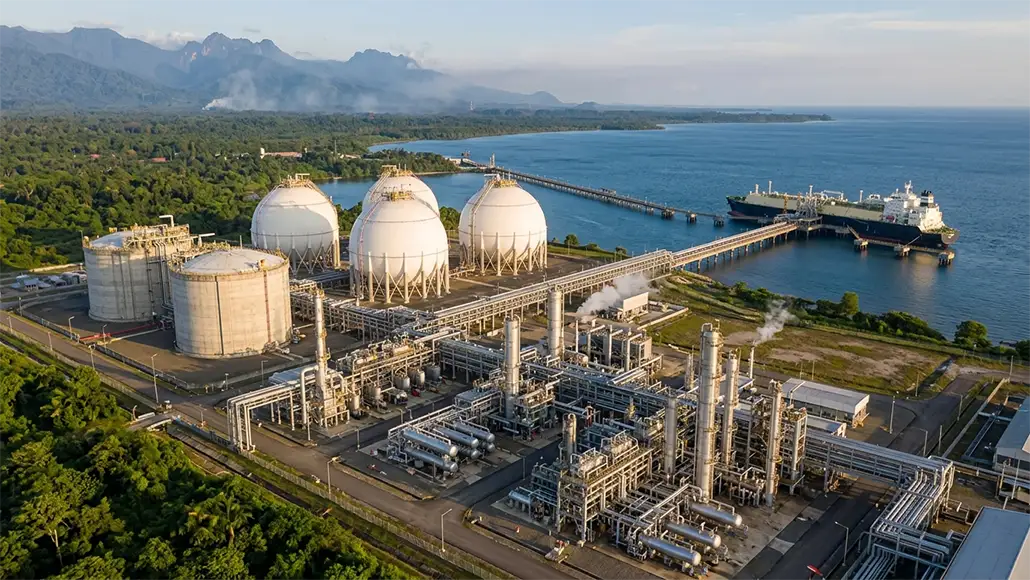
Indonesia is speeding up the development of many big energy projects in order to increase production and attract foreign investment in its energy and infrastructure sectors.
The most recent milestone happened in March 2026, when Conrad Asia Energy went on to make a final investment decision – FID for its Mako gas project, which is in the Duyung production sharing contract – PSC area located in the West Natuna Sea. The project is worth about USD320 million and is expected to start delivering gas in the fourth quarter of 2027. It is thought to be one of the largest undeveloped gas resources within the area.
Energy Independence
Jakarta, apparently, is working on this project as part of a larger effort in order to boost activity in the upstream sector and also cut down on its dependence on energy imports. By 2025, the government wants to produce 1 million barrels of oil and 12 billion cubic feet of gas every day. In order to reach these goals, they will need a steady stream of new developments.
The Abadi LNG project in the Masela Block, which is being led by Inpex from Japan, is one of the biggest plans in the works. In February 2026, the USD20 billion development went on to secure environmental approval under the AMDAL framework of Indonesia, which was a big step toward meeting all the regulations.
The fact is that if it gets approved, Abadi LNG could go on to make 9.5 million tonnes of LNG a year and have carbon capture and storage – CCS systems integrated to lower the project’s emissions.
The Tangguh Ubadari, CCUS, and Compression – UCC project, run by bp and partners in West Papua, reached FID in late 2024. It is thought to be worth $7 billion. The goal of the project is to open up about 3 trillion cubic feet of extra gas and make the Tangguh LNG complex last longer.
Eni from Italy is also moving forward with plans for a new production hub in the Kutei Basin. The company is expected to approve the development of the Geng North as well as Gendalo-Gendang gas fields over there. The projects would work together so as to create a Northern Hub development concept that would improve the energy and infrastructure sectors of the region and make offshore gas extraction more profitable.
Expansion of infrastructure
The wave of investment from upstream companies comes at the same time as the construction industry is growing quickly in Indonesia. This industry, understandably, is now a key part of Southeast Asia’s largest economy.
According to the law firm HFW, investment in the sector reached about USD280 billion in 2024 and is expected to go over USD300 billion. A lot of the spending is going toward improving the country’s transportation and industrial infrastructure so it can get better connected to global supply chains.
The Indonesian government has prioritized big projects like roads, railways, ports, airports, power plants, refineries, water systems, and urban transit networks over the past ten years. The change is part of a larger economic plan so as to move the country away from exporting raw materials and toward the value-added refining, manufacturing, and energy production. This is surely going to create a need for advanced engineering and logistics services.
It is worth noting that President Prabowo Subianto’s government in Indonesia keeps pushing for big infrastructure projects and public-private partnership – PPP models to bring in foreign investment. European and Middle Eastern companies, along with international contractors and investors from Japan, China, South Korea, and Australia, are pretty much involved in the infrastructure pipeline of the country.
But the scale and location of Indonesia make project logistics very difficult. Mike Schoofs, who is the global head of project logistics business development at Kuehne + Nagel – K+N says that the 17,000 islands of the country make it hard to do business, but they also offer a lot of opportunities.
Project focus that’s evolving
K+N’s operations in Indonesia have changed from focusing on the mining sector to having a large market share in the country’s oil and gas industry. The company is at present working on an expansion for the biggest LNG producer of the country. It has also been able to renew the resupply contract for that facility for four more years. Schoofs adds, “We have worked tirelessly to build trust with our customers. As complexity in their supply chain increased, we evolved our service offering to ensure reliability and scalability. Setting out from our first-class oil and gas supply base at Lamongan Shorebase, we subsequently added marine resources and an organization of highly skilled specialists to operate them.”
Schoofs also went on to point toward the development of the Masela field as an example of long-awaited progress. He said, “The field was discovered about 20 years ago and is now taking promising final steps into development.”
The country’s project sites are getting increasingly difficult to reach due to their remote locations and massive scale. Project owners and EPCs happen to have stringent HSE requirements and strict marine assurance programs, however, the fleets of LCT, container, and multipurpose vessels are outdated.
To move Indonesia’s energy and mining sectors forward, they need to completely redesign their supply chains and make use of the best practices from other markets, such as Australia or Europe. As a result, the heavy-duty fabrication industry in Indonesia is also growing its skills, especially when one talks of steelwork for the energy sector and modular process equipment, along with marine structures.
Batam, which is the largest fabrication hub in the country, used to only work on projects for other countries. However, the push from the government to use more local parts under the Tingkat Komponen Dalam Negeri – TKDN framework has boosted the local demand. This has led to more growth across other parts of Indonesia, such as Bintan or Java, where Lamongan Shorebase has gone on to add fabrication capacity, and K+N is the exclusive logistics partner for its operator.