

























The early summer heat had been sticky and oppressive outside the Renhe grain depot in Hangzhou, capital of Zhejiang Province in the east. But inside, grains of rice were sitting in a crisp, 19-degree-Celsius climate-controlled suite.
This is the cutting edge of China’s green grain storage revolution. The National Food and Strategic Reserves Administration – NFSRA went on to announce at a national conference on integrated green storage technology held in the city in late April 2026 that 40 new demonstration facilities will be established throughout the country this year, and by 2027, 100 model granaries will span each of the seven major grain ecological regions.
China, the world’s top grain producer, went on to harvest a record 714.88 million tonnes in 2025. The nation’s annual output reached the 700 million tonne mark for the second year in a row, said the National Bureau of Statistics.
But the country remains tight on a long-term supply-demand basis, even with the bumper harvests. The development of storage technologies has thus grown into a strategic lever for guaranteeing food security.
In this regard, the green grain storage integration and demonstration program was first rolled out in 2025, with the inaugural batch of 30 pilot sites implemented across the country.
This approach is already beginning to pay off. China now has more than 730 million tonnes of standard warehouse capacity, among which 220 million tonnes is equipped with low-temperature and quasi-low-temperature storage equipment, and over 55 million tonnes with controlled-atmosphere technology, as per the NFSRA. The total loss rate over a full storage cycle has been kept below 1%.
At Renhe depot an array of technologies was on vivid display.
According to Wan Xiaojin, director of the depot who was pointing at a thermohygrometer on the warehouse wall, “The reading right now shows 19 degrees Celsius and 65 percent humidity inside, well within the technical standards for quasi-low-temperature grain storage.”
The air-supported membrane silo is an essential component enabler of that steady climate and is now being carried out in multiple regions. The depot staff warmly call it a giant breathing white chubby, a tongue in cheek name for the bulky, dome-shaped structure.
The grain inside is like an air-conditioned room where the temperature and humidity are always the same.
The secret lies in three layers of technology built into the roof, the grain pile as well as the walls – solar shielding, active cooling as well as energy efficiency, all working together so the grain sleeps in a good house, stated the chief technician to manage the membrane silos, Wang Hongli.
But even a good house needs to be health checked. Before it goes inside the warehouse, each batch of grain undergoes an intelligent inspection gate with highly precise detectors – a kind of CT scanner for kernels.
To cover the quality inspection without blind spots, five images of every single maize kernel are captured from five distinct angles. It takes less than 100 seconds to complete the whole scan for a standard 100-gram maize sample, said Wang Liangliang, oen of the technicians from the grain smart check team.
Then there happens to be the dock, which had one of the biggest surprises.
There is a just docked grain ship on the Grand Canal, which is the longest artificial canal in the world, from Beijing to Hangzhou. A suction pipe went into the hold and the wheat was sucked up like water via completely closed pipelines and went straight to the warehouse. From ship to silo, not one grain was spilt and the site was practically dust free.
Remarked Ma Guojun, the head of the storage and transport section at the depot, “The entire assembly line operates through sealed pipelines. Our operation won’t be affected no matter how the weather changes.”
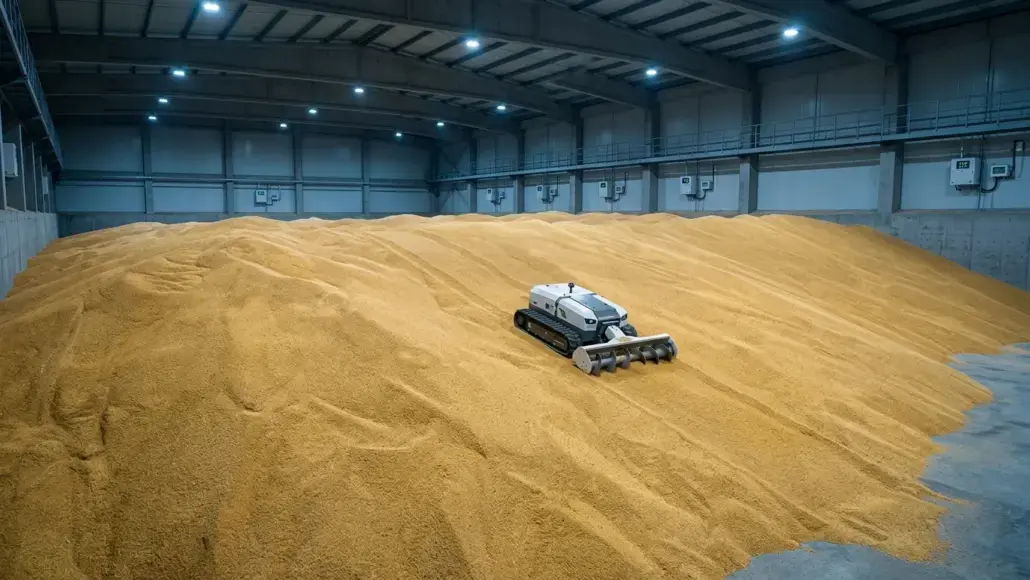
Once the grain is in, another previous headache is dealt with. Flattening the grain pile once involved sending workers a few meters down into the mass in order to shovel it level by hand. The task now is to a second-generation leveling robot, which can be autonomous for approximately eight hours on a single charge.
The technologies on display in Hangzhou are more than just local upgrades.
Rather, they are part of a push orchestrated nationwide. The objective is to develop a unified green storage system with five pillars – warehouse performance upgrade, clean and effective grain handling, smart monitoring and early warning, green pest along with mould control and stringent evaluation of all measures toward scientific benchmarks — a system administrators say is targeted to local conditions, and not generic.
China is building safe, green and smart granaries to make sure that every single grain stays fresh by encouraging green, smart and unified development, said the chief researcher at the NFSRA academy, Zhang Zhongjie.