

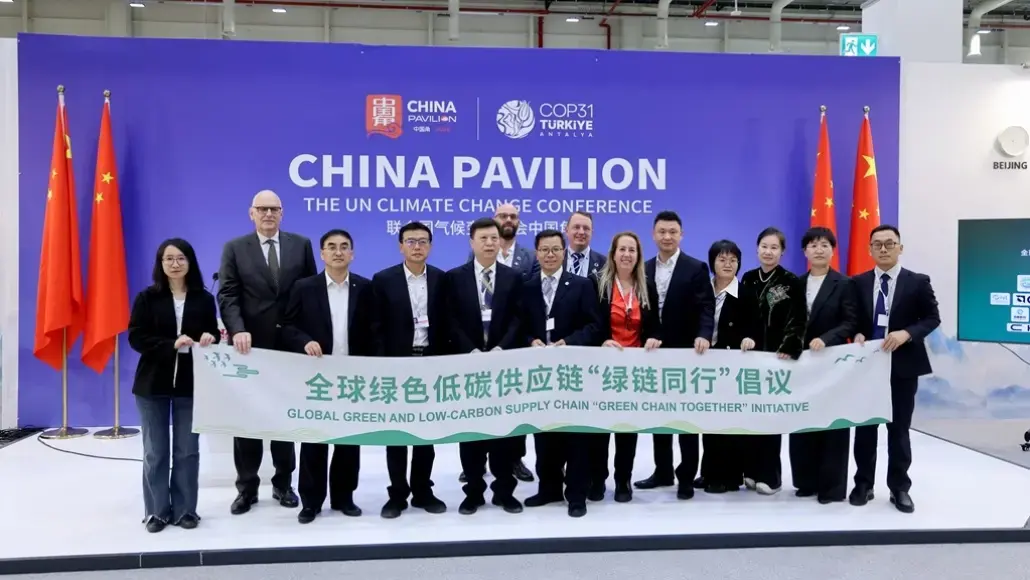
China has gone ahead and launched a global action when it comes to green and low-carbon supply chains at the China Pavilion on Thursday, November 19, 2026, during a side event of the 31st UN Climate Change Conference – COP31 that was held in Antalya, Türkiye.
It is well to be noted that the “Green Chain Together” initiative covers important topics such as full life-cycle environmental data, green and low-carbon evaluation guidelines, and mutual acknowledgement of certification outcomes. It advocates for a global supply chain mechanism built around joint consultation and development as well as action, with the goal of offering an open and shared platform for collaboration on the green transformation of global industrial and supply chains.
The green and low-carbon supply chains initiative has three primary goals, says the Chinese Research Academy of Environmental Sciences, which is the co-initiator of the project.
It first calls for creating a common basis of full life-cycle data, with datasets encompassing every aspect of the chain right from raw material prep and production to transportation, usage, and waste disposal. The goal is to make environmental data more precise, equivalent, and trustworthy.
Second, it proposes the joint formulation of green and low-carbon evaluation rules, supply chain labeling, and management norms, along with transparent processes for dynamic review of suppliers. This will better guide enterprises, especially small and medium-sized ones, to play a part in global green competition.
Third, it seeks to enable green trade beyond borders by means of a common disclosure framework and harmonized verification channels, with an aim to foster mutual acknowledgement of certification and enhanced trust in environmental information.
For the Paris Agreement, 2026 is the beginning of a new decade, with the global climate governance shifting from negotiating rules to execution.
Green and low-carbon supply chains are an essential means to translate climate pledges into industrial action, said the deputy director-general of the Department of Climate Change under the Ministry of Ecology and Environment of China, Liu Yang. Such initiatives can help grow worldwide climate objectives while enhancing the ecological performance and robustness of industrial and supply chains by promoting leading companies to engage businesses throughout their supply chains in order to lower emissions.
Liu further said that cross-border supply chains continue to encounter challenges such as varying environmental data, varying evaluation rules, and difficulty in recognizing certifications in various countries. China is open to working together with other organizations to enhance comprehensive life-cycle environmental data systems, establish unified standards, and encourage mutual recognition of certification outcomes so as to make worldwide industrial and supply chains greener and more environmentally friendly.