

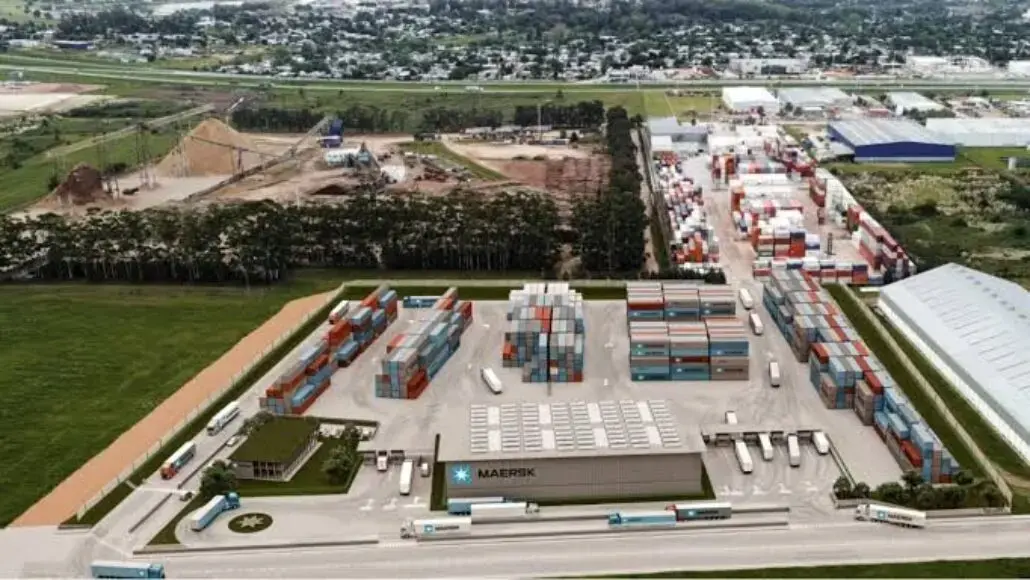
Maersk grew its integrated logistics competencies in Uruguay with an infrastructure built to handle global cargo flows and to combine container, cargo, and logistics services in a single place with the opening of its new logistics center in Montevideo on November 12, 2026.
The facility was formally inaugurated in an event that took place in Montevideo, which was attended by Yamandú Orsi, President of the Oriental Republic of Uruguay, and the Secretary of the Presidency, Alejandro Sánchez, as well as the Minister of Transport and Public Works, Lucía Etcheverry, along with President for Latin America and the Caribbean at Maersk, Antonio Dominguez, and President for the East Coast of South America at Maersk, Ricardo Rocha, as well as customers and business partners along with executives.
The facility is in the access corridor of Route 1, which lies between Camino Cibils and Camino Burghi, reinforcing the connection with the Port of Montevideo as well as the region. The development constitutes a completely private investment of over USD 20 million.
It is an integrated configuration that offers more flexibility for cargo between inland logistics operations as well as the Port of Montevideo while facilitating global cargo transiting Uruguay. By co-locating cargo solutions, container handling, and also equipment services, Maersk is able to offer customers, who are prepared to take integrated solutions, services that minimize handovers among different logistics activities while providing improved visibility all over their supply chain.
As per the president for Latin America and the Caribbean at Maersk, Antonio Dominguez, “Uruguay plays an important role in connecting regional supply chains with international markets. This investment strengthens our capabilities in Montevideo and our connection with the Port of Montevideo while expanding the solutions we can offer customers moving cargo through the region. It reflects our commitment to investing in the logistics infrastructure needed to support trade and growth across Latin America.”
The new facility integrates container and cargo services within a 71,000-square-meter logistics platform, enhancing the abilities and connectivity of Maersk with the Port of Montevideo as well as regional trade flows.
The new building covers 71,000 square meters and offers storage capacity for 7,000 TEUs, in excess of 1,000 pallet positions, and 140 reefer plugs, as well as 3,200 square meters of covered cargo handling and storage area. The site integrates standard equipment services, cargo services, and logistical capabilities into a unified and flexible logistics infrastructure.
Empty-container services consist of container pickup, return shipment and examination, empty-container storing, equipment upkeep and repair, availability of equipment, and specialised solutions. Cargo services consist of container setup, stuffing and de-stuffing, cargo storage as well as examination, full container holding, reefer power supply, value added services as well as integrated logistics management.
Says Ricardo Rocha, the president for the East Coast of South America at Maersk, “By bringing container services, cargo handling, storage, and logistics capabilities together in one location, we can simplify operations for our customers and provide greater flexibility and visibility. This facility gives us the infrastructure and scale to support different cargo flows through Montevideo and connect inland operations more efficiently with the port and international markets.”
As part of growing its integrated logistics competencies in Uruguay, the structure by Maersk has been developed to promote operational effectiveness and to include features that minimize the release of greenhouse gases. The project is anticipated to be awarded LEED Gold certification and consists of solar panels for renewable electricity generation, computerized temperature and climate-control equipment, moisture controls, and architectural solutions to maximize natural light as well as solar energy.
The facility infrastructure consists of 6 inbound and as many outbound gates, container handling machinery, and terminal tractors. Its service model is underpinned by operational effectiveness, modern facilities, scalable capacities, bonded and national processes, supply chain adaptability, and integrated logistical services.