




























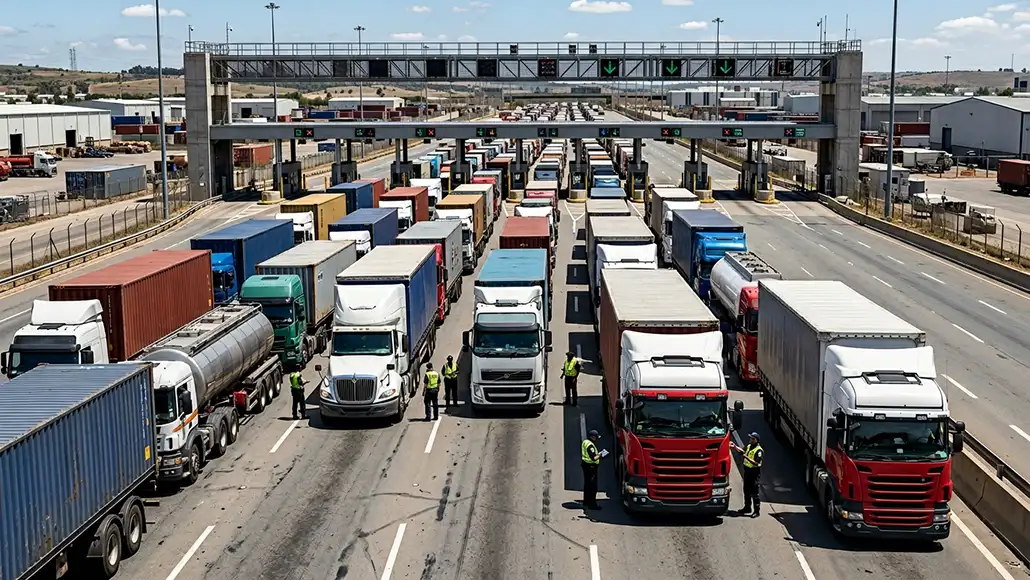
As the 2026 review of the United States-Mexico-Canada Agreement – USMCA approaches, the growth of Chinese investment and manufacturing activity along with role of China in Mexico supply chains is transforming North American supply chains and creating new concerns with regard to trade compliance, tariffs as well as the future of cross-border freight.
That story about China using Mexico as a backdoor into the U.S. market is true but simplified too much, according to the co-CEO of The Nearshore Co., Jorge Gonzalez Henrichsen.
“The answer to the question is yes and no, things are for real, and you see it in the numbers, but the word ‘backdoor’ has a negative connotation,” Henrichsen went on to tell FreightWaves.
The fact is that in recent years, role of China in Mexico supply chains with Chinese companies have increased their presence within Mexico, especially after the COVID-19 pandemic rocked the global supply chains. The shift was mainly driven due to U.S. companies trying to lower the tariff exposure along with geopolitical risk that is associated with China, Henrichsen said.
“There has been a spike, probably since COVID, both in manufacturing facilities… and EVs is a big, big, big… something that’s notorious,” said Henrichsen.
From tariffs to nearshoring – an adjustment
Instead of leaving the U.S. market, many Chinese suppliers have gone ahead and shifted their business models by way of moving production to Mexico, establishing local entities, alongside hiring Mexican labour so as to take advantage of the preferential trade treatment in the USMCA.
A typical scenario, according to Henrichsen, is U.S. buyers severing relationships with China-based suppliers, ultimately to come across those same suppliers cropping up in neighbouring Mexico.
The Chinese company would respond with “I’ll go to Mexico. “I’ll be a Mexican company,” he stated.
Some critics say companies could as well avoid tariffs with little processing or relabelling; however, Henrichsen said the majority of activity is either in a legal grey zone or completely compliant as firms try to conform to rules-of-origin requirements.
China increases investments in Mexico
Chinese foreign direct investment – FDI in Mexico has surged since 2017, particularly following the conclusion of the US-China trade war and the adoption of the USMCA in 2020 that went on to help spur a new wave of manufacturing-orientated investment, reported the Federal Reserve Bank of Dallas.
Official data indicates that the net FDI of China to Mexico was approximately $2.3 billion from 2017 to 2024, however private estimates point to the real number becoming significantly higher, taking into account investments funnelled by means of offshore entities as well as greenfield investments.
It is well to be noted that one of the largest single investments was a $5 billion factory from Lingong Machinery Group, which happens to be China-based, announced in October 2023 in Monterrey, which is the city in Mexico.
The fact is that the investment of China is indeed growing fast but that fact is that it is still far from that of the US and various other G7 countries and accounts for a small share of total FDI into Mexico even though the Chinese companies happens to be playing a progressively visible role when it comes to nearshoring supply chains.
Economic upside – and building tension
The arrival of the Chinese companies has indeed gone ahead and actually boosted industrial development through northern Mexico, thereby increasing the employment and at the same time, manufacturing capacity as well as supplier development.
Henrichsen said, “I think that type of arrangement is very positive for Mexico… they are bringing… know-how in manufacturing… and that is very positive for the ecosystem.”
But the trend is causing a lot of friction. Mexican firms are encountering fresh rivalry, and policymakers in Mexico and the U.S. feel a growing obligation to deal with issues related to Chinese overcapacity as well as supply chain dependence.
Recent talks among the U.S. Trade Representative
Ahead of the USMCA review, Jamieson Greer, along with Mexican officials, has been concentrating on strengthening rules of origin, bolstering economic security measures as well as aligning tariff policies.
Meanwhile, U.S. officials have suggested that tariffs, particularly when it comes to autos and steel, are expected to remain unchanged even after negotiations are resolved.
USMCA review – Adjust, not overhaul
Henrichsen expects the deal will pass the 2026 review, but with major changes, especially on standards of origin and enforcement.
“My forecast is that the USMCA will continue to exist… but it will be tweaked… both to appease some of the U.S. forces… and also to see genuine improvements,” Henrichsen said.
Rules of origin are likely to be a key battleground, as U.S. policymakers seek to restrict Chinese content within North American goods all while maintaining the integrated regional supply chains.
Possible modifications could include tougher content thresholds and better enforcement mechanisms along with greater coordination on tariffs as well as investment screening intended to target China-linked activity, experts suggest.
Investment slows in the face of uncertainty
It is well to be noted that there is a lot of interest in nearshoring, but companies are waiting to see how the negotiations will play out and are holding off on big capital outlays.
Henrichsen said, “A lot of the companies… are saying, ‘you know what? Let’s wait a couple of months’… The suspense around the USMCA is making them wait.”
However, he emphasised that the long-term case for Mexico is still in place for many manufacturers, especially those that serve the U.S. market, no matter what policy changes take place.
“For some companies, don’t wait, as there’s nothing that’s going to happen that’s going to change the structure, just move fast and nearshore,” Jorge Gonzalez Henrichsen opined.