



![Busy port scene with stacked shipping containers, large cranes, and cargo ships in a bay, beside a coastal highway and rail line on the right.] }} (Note: The input requires a valid JSON with an array of strings in altTexts. Here is a corrected version.)Let's provide proper JSON.](https://www.supplychaininforms.com/wp-content/uploads/2026/09/trade-and-logistics-infrastructure-218x150.webp "Turkey Looks to Upgrade Trade and Logistics Infrastructure")

























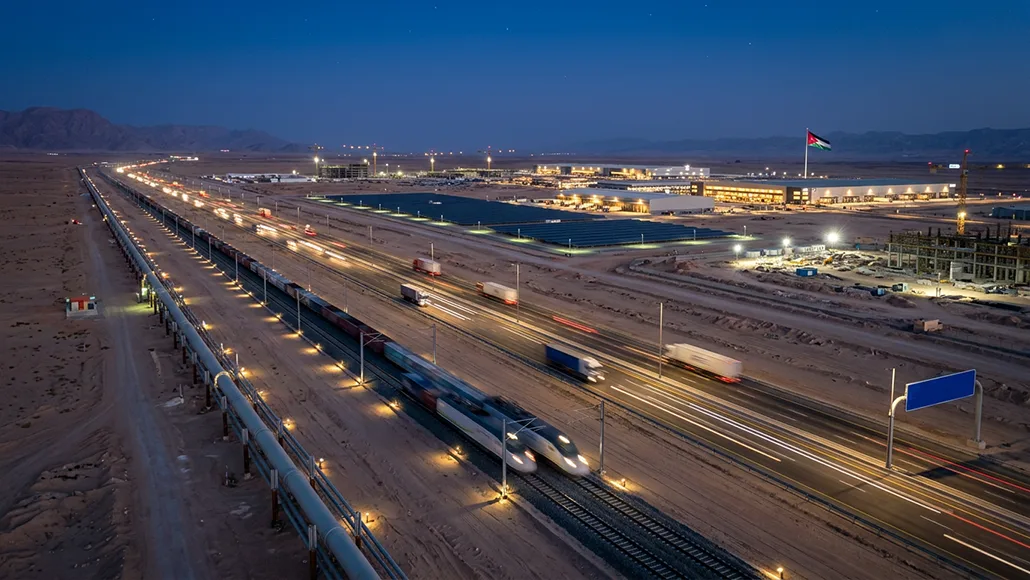
The execution of the railway agreement between the United Arab Emirates and Jordan marks the beginning of the Port of Aqaba railway project, a landmark in the development of the transportation system. It is a crucial link in the chain between the mines, logistics infrastructure and the mining industry to establish a logistics hub locally, regionally and internationally.
The United Arab Emirates – UAE and Jordan have signed an agreement for the development of Jordan’s railway network involving the Port of Aqaba railway project and the establishment of the joint venture UAE-Jordan Railway Company – UJRC.
The agreement was signed by the Minister of Energy and Infrastructure, Suhail bin Mohamed Al Mazrouei, on behalf of the United Arab Emirates and by Nidal Al-Qatamin, Minister of Transport, on behalf of Jordan.
Prime Minister Jafar Hassan, along with Sheikh Mansour bin Zayed Al Nahyan, Vice President of the United Arab Emirates, Deputy Prime Minister of the Cabinet as well as Chairman of the Presidential Council, witnessed the signing of agreements on starting the actual execution procedures for the Aqaba Port railway project as well as the establishment of the joint venture company tasked with the development and operation of this project.
The Aqaba Port railway project is based on a balanced partnership
between two parties – Jordan, which is represented by the Phosphate and Potash Companies, the Government Contributions Company, as well as the Social Security Funds Investment Fund, and the United Arab Emirates via Lemad Kabda, which is the sovereign investment platform of the Abu Dhabi government.
It is worth noting that it is the largest railway project of its kind in Jordan, with a projected total investment of around USD 2.3 billion, to be jointly executed by the two countries. It includes a set of main infrastructure components, including railway lines and bridges as well as overpasses, all designed and built according to international standards when it comes to rail transport.
The project will make a significant contribution to enhancing the competitiveness of the Port of Aqaba upon its completion, making it a key regional hub for transport and logistics along with maritime services. At the same time, this will create new opportunities for social and economic growth, notably in the south of Jordan and also the Aqaba area.
This initial stage marks the first tangible move towards the creation of an advanced national railway network in Jordan. Long term, the goal is to connect Aqaba and the entire country to the neighboring Arab states, and to connect the Port of Aqaba into transport corridors to ports in Syria as well as the Mediterranean region.
Rail Network for Mining Sector and Logistics Development
The project will construct a modern rail network of about 360 km to connect the primary phosphate and potash mining areas with the industrial port. The route is split into two main corridors that connect production centres located in the Al-Shidia and Ghor Safi regions.
It involves the movement of some 16 million tonnes of raw materials annually, of which almost 13 million tonnes are phosphates and 2.6 million tonnes are potash. This volume will be a major contribution to increasing the export capacity of Jordan and also raising the competitiveness of the mining sector in international markets.
At the same time, the authorities have started plans to extend the railway link to the mining areas of Al-Shidia Basla, with an extension to the Ma’an development region in the south of the country. There is also an analysis of the project for the development of a logistics corridor connecting Ma’an with the Port of Aqaba, which could as well become an integrated hub of industrial and customs as well as transportation activities.
Project financing is expected to close in the first quarter of 2027, and construction is expected to take roughly five years based on a phased timeline.
The government shall compensate the landowners who are affected by expropriations in the Al-Ghor area for execution or offer alternative land on fair terms where possible. The Al-Ghor area is a part of the Jordan Valley, a fertile tectonic depression 110 km long, between the Sea of Galilee and the Dead Sea.
The project is being developed in partnership with the United Arab Emirates, which is providing sophisticated technical expertise in the field of railway infrastructure and assistance in the development of national skills essential to the upkeep and operation of this type of network.
UAE-Jordan Joint Railway Company
A bilateral contract established the UAE-Jordan Railway Company as a joint venture between L’IMAD Holding in Abu Dhabi and multiple institutional partners in Jordan. This structure is a mechanism of strategic cooperation for the purpose of supporting the establishment of modern railway infrastructure in the region.
According to the agreement, the new company will be mainly responsible for the execution, maintenance, and operation of the national railway network in Jordan. Operational activities will be undertaken in partnership with Etihad Rail, the company which is developing and operating the national railway network of the United Arab Emirates.
The joint venture is of particular importance in the transfer of technical and managerial know-how to the Jordanian side and also in the development of modern operating standards when it comes to the railway sector. It will also enhance economic cooperation between both countries and help build sustainable infrastructure that can support large-scale logistics along with industrial projects in the long term.
Economic Effects of Aqaba Railway Corridor
The Aqaba Port railway project forms part of a broad joint investment agreement signed at the end of 2023, worth around $5.5 billion. The aim of the initiative is to promote the development of strategic economic sectors and accomplish a structural change within transport and logistics through directly connecting mining areas with ports.
This infrastructure will allow for a reduction in transportation costs, simplification of logistics along with export chains, and an increase in the volume of exports of phosphate and potash by two times. Thus, the project is an essential component for the mining sector, enhancing the performance of operations and boosting the competitive edge of the industry and related sectors.
On a larger scale, the Aqaba rail corridor is envisioned as the start of a network that would reach the Madouna region, which is a logistics hub southeast of Amman. The project additionally opens up connectivity routes north via Syria to Mediterranean ports and on to Turkey and Europe. It also strengthens trade ties with Saudi Arabia as well as the Gulf States, promoting regional economic integration, along with positioning Jordan as a major logistics hub when it comes to the Middle East.
A vital export hub
The Port of Aqaba, which is the primary maritime gateway of Jordan and also the sole direct access to the Red Sea, is situated in the south of the country on the Gulf of Aqaba. Its geographical location makes it an integral part of the national economy, concentrating the vast majority of the foreign trade flows, imports and exports of the country.
The main exports of Aqaba are phosphates and potash, the basis of the mining industry of Jordan, as well as petroleum products, grains and industrial goods. The port is of strategic importance and has been integrated into larger development of infrastructure plans, such as the Aqaba railway project that seeks to link production areas directly with the port, thereby reducing logistics costs and improving competitiveness of exports.
The port includes the Aqaba Container Terminal – ACT as a key component, which acts as the logistics pillar for the Aqaba Special Economic Zone Authority – ASEZA. It is one of the most significant transit hubs in the Middle East, which serves both regional and international markets, including Iraq, Syria, Saudi Arabia, and the West Bank as well as Lebanon.
In recent years, the volumes of ACT have grown significantly, surpassing the mark of 1,000,000 TEU for the first time, which is indeed a historic achievement, which demonstrates the growth of operational capabilities and adaptation to the necessities of modern logistics based on advanced technologies.
In 2006, the Aqaba Development Company – ADC went on to sign a 25-year build-operate-transfer agreement with APM Terminals so as to consolidate the development of the terminal. APM Terminals happens to hold a controlling interest in the management of the port infrastructure.